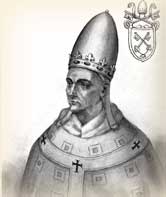
This day, March 28, 1288 was Easter. As could be expected,
Rome, the center of Western Christianity
, was electric with a sense of
importance. Easter has always been the most significant day in the
church calendar, the day on which Christ was vindicated by rising in
triumph from the grave. The day calls for special celebrations,
especially in Rome.
The occasion was charged with more than the usual significance this
time, however. It would be the first time that Girolamo Masci celebrated
Easter in the capacity of pope. Newly-elected, he had taken the name
Nicholas IV. Adding to the importance of the occasion was the presence
of Rabban Bar Sauma, an enthusiastic envoy from the Far East.
Bar Sauma was a Nestorian, a member of an ancient sect of Christians.
Born near Beijing, he traveled West to visit Jerusalem shortly after
Marco Polo arrived in the East. In the Mideast, Bar Sauma was delegated
to act as ambassador for newly-elected Patriarch Mar Yabahalla III. But
there was no pope in Rome, so negotiations could not be completed. Bar
Sauma seized the opportunity to pass on to France and possibly England.
A partial record of his travels has come down to us.
Back in Rome, the ambassador found Nicholas IV now installed as pope.
Nicholas received him with open arms. He allowed Bar Sauma to celebrate
the Eucharist. And when the onlookers had seen his actions, they
rejoiced and said, "The language is different, but the use is the same."
On Palm Sunday, the pope gave Bar Sauma the Eucharist in front of a
throng of tens of thousands, roaring their amens so that the ground
shook. "And Rabban Sawma rejoiced greatly in receiving the Eucharistic
Mystery from the hand of Mar Papa. And he received it with tears and
sobs, giving thanks to God and meditating upon the mercies which had
been poured out upon him."
Today's Easter service was almost an anti-climax. "And on the day of
the Sunday of the Resurrection Mar Papa went to the holy church of my
Lady Mary. And he and the Cardinals, and the Metropolitans, and the
Bishops, and the members of the congregation saluted each other, and
they kissed each other on the mouth, and he celebrated the Mysteries,
and they receive Eucharistic Mystery, and then he returned to his Cell.
And he made a great feast, and infinite gladness."
Soon afterwards, Bar Sauma asked permission to return to his own
people. The pope wanted to keep the old man, but Bar Sauma reminded him
that he had obligations to those who sent him. The Asian Christian also
pleaded that he might be allowed to take back a few relics. Nicholas
gave him a fragment of cloth reputed to be from Mary's scarf as well as
small pieces from the bodies of saints. Nicholas also furnished him with
gold for his journey.
Back in Persia, Bar Sauma, with the help of the king, built a church
to house the relics. When he died, his body was buried beside that
church.
Bibliography:
- Budge, E.A. Wallis. The Monk of Kublai Khan, Emperor of China;
or The History of the Life and Travels of Rabban Sawma, Envoy and
Plenipotentiary of the Mongol Khans to the Kings of Europe and Markos
who as Yahbh-Allaha III Became Patriarch of the Nestorian Church in
Asia. London: The Religious Tract Society, 1928.
- Montgomery, James A. The History of Yaballaha III, Nestorian
Patriarch and of his Vicar Bar Sauma, Mongol Ambassador to the Frankish
Courts at the end of the 13th century. New York: Octagon, 1966.
- Outerbridge, Leonard M. The Lost Churches of China.
Philadelphia: Westminster Press, 1952.
- "Rabban Bar Sauma." Encyclopedia Britannica 1911.
Read this article at - http://www.christianity.com/church/church-history/timeline/1201-1500/bar-sauma-in-rome-attended-easter-services-11629847.html

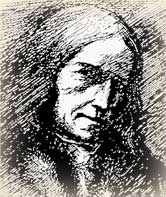 If you check the index of your hymnbook, you will likely find a hymn
titled "Thou hidden love of God" by Gerhard Tersteegen. Can God's love
be hidden? There were five terrible years after Tersteegen became a
Christian when he had no sense of God whatever. He came close to
despair.
If you check the index of your hymnbook, you will likely find a hymn
titled "Thou hidden love of God" by Gerhard Tersteegen. Can God's love
be hidden? There were five terrible years after Tersteegen became a
Christian when he had no sense of God whatever. He came close to
despair.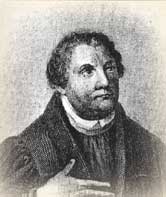 When Luther sparked church reformation in Germany, there was bound to
be a backlash. In those intolerant days, when church and state acted
together, there was no choice in matters of faith. Someone had to be the
first to die for the new ideas. One of the first two martyrs was Adolf
Clarenbach.
When Luther sparked church reformation in Germany, there was bound to
be a backlash. In those intolerant days, when church and state acted
together, there was no choice in matters of faith. Someone had to be the
first to die for the new ideas. One of the first two martyrs was Adolf
Clarenbach.
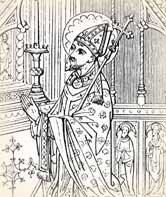 Edmund of Abingdon, Archbishop of Canterbury, had a motto: "Caclum
dives ingredi." It meant "to enter heaven rich." It was a pun on his
family name, for the merchant's son was named Edmund Rich.
Edmund of Abingdon, Archbishop of Canterbury, had a motto: "Caclum
dives ingredi." It meant "to enter heaven rich." It was a pun on his
family name, for the merchant's son was named Edmund Rich.

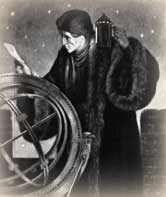 Poland is known today as one of the most Catholic of European
countries. The native land of Pope John Paul II, the faith of its people
helped bring down the Soviet empire. There was a time, however, when it
appeared that Poland might become Protestant.
Poland is known today as one of the most Catholic of European
countries. The native land of Pope John Paul II, the faith of its people
helped bring down the Soviet empire. There was a time, however, when it
appeared that Poland might become Protestant. (Apple
Valley, CA)—Molested a few times when he was a child, Paul Gualtieri
dabbled with homosexuality as a largely unsupervised 13-year-old in Palm
Springs. (Photo via
(Apple
Valley, CA)—Molested a few times when he was a child, Paul Gualtieri
dabbled with homosexuality as a largely unsupervised 13-year-old in Palm
Springs. (Photo via 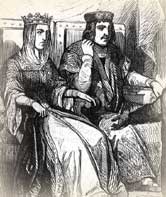 The year 1492 is most often associated with Columbus and his discovery
of America. But another event of tragic proportions developed that year.
It gave the world the Sephardic Jews (so called because Sepharadh was a
region of Spain where many Jews had settled).
The year 1492 is most often associated with Columbus and his discovery
of America. But another event of tragic proportions developed that year.
It gave the world the Sephardic Jews (so called because Sepharadh was a
region of Spain where many Jews had settled).

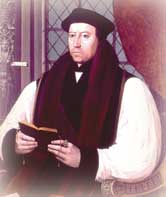 When Thomas Cranmer learned he had been named
Archbishop of Canterbury by King Henry VIII, he balked. Visiting Germany
at the time to promote the King's interest in a divorce, he dawdled seven
weeks getting back to England. Although the King's word was law,
Cranmer hesitated to accept the position.
When Thomas Cranmer learned he had been named
Archbishop of Canterbury by King Henry VIII, he balked. Visiting Germany
at the time to promote the King's interest in a divorce, he dawdled seven
weeks getting back to England. Although the King's word was law,
Cranmer hesitated to accept the position.


 Good guy or bad guy?