Showing posts with label The Blood of Jesus. Show all posts

May 7, 2015

Jesus' Death: Six Hours of Eternity on the Cross

Lambert Dolphin
 
A superficial reading of the gospel narratives concerning the death of Jesus will show that He was nailed to the cross at 9 o'clock in the morning, and was dead by 3 in the afternoon. His terrible ordeal, it would seem, was over in a mere six hours.

The agony in the Garden of Gethsemane the night before had been an ordeal in prayer before His Father that we can scarcely understand. The writer of Hebrews comments on this incident,
"In the days of his flesh, Jesus offered up prayers and supplications, with loud cries and tears, to him who was able to save him from death, and he was heard for his godly fear. Although he was a Son, he learned obedience through what he suffered..." (Hebrews 5:7, 8)
Then, too, Jesus had been up the rest of the night without sleep enduring beating, cruel mockery and unspeakable brutality. The next morning, the Romans scourged Him. (Mark 15:15, John 19:1).
Jesus was already greatly weakened when he carried his cross, stumbling, to the place of crucifixion alongside the main public highway, probably just outside the Damascus Gate.

Several medical doctors and forensic experts have written books about the common Roman form of execution---death by crucifixion. Often the process took several days. The nailing of hands and feet forced the victim to push up against the weight of his own body to take a single breath. In the hot sun, terrible thirst ensued and death came in most cases from suffocation amidst great pain. The victim was also naked and humiliated---death on the cross was reserved for the most wretched of all criminals.
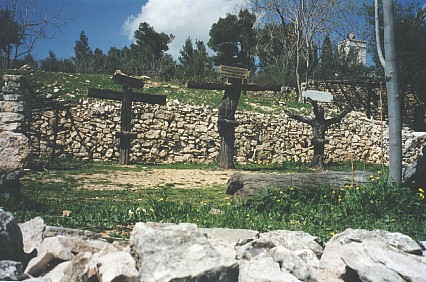
Wood was in short supply in Israel in Roman times. It is likely that small trees (such as these olive trees) were pressed into service to handle the thousands of executions. Crosses were stuck into the ground along major thoroughfares to offer maximum public viewing which included public ridicule and scorn. The terrible nature of this punishment helped enforce Rome's control over the Jews whom they hated anyway. In the Law of Moses hanging a criminal on a tree or cross was reserved for the most serious crimes, "And if a man has committed a sin worthy of death, and he is put to death, and you hang him on a tree, his corpse shall not hang all night on the tree, but you shall surely bury him on the same day (for he who is hanged is accursed of God), so that you do not defile your land which the Lord your God gives you as an inheritance." (Deuteronomy 21:22-23)

There is much more to the death of Jesus on the cross than the visible suffering, terrible pain and suffering, and the incredible ignominy of such a horrible death for One who was not only innocent but also the very Son of God.

The Cosmic Struggle on the Cross

After speaking of Jesus and his role in the creation of the universe Paul in his letter to the Colossians tells us about invisible events taking place outside of the physical realm, and outside of our ordinary space-time continuum during the dying of Jesus on the cross,
...in Jesus all the fullness of God was pleased to dwell, and through him to reconcile to himself all things, whether on earth or in heaven, making peace by the blood of his cross. And you, who once were estranged and hostile in mind, doing evil deeds, he has now reconciled in his body of flesh by his death, in order to present you holy and blameless and irreproachable before him. (Col. 1:19-22)
The above passage reveals that not only did Jesus take upon Himself the sins of mankind when He died for us on the cross, but He also met fully the onslaught of demons, fallen angels, and all the power of evil forces in the heavens as well, disarming all of them completely.

Jesus' victory over man's greatest enemy, death, is boldly stated in the letter to the Hebrews:
"Since therefore the children share in flesh and blood, he himself likewise partook of the same nature, that through death he might destroy him who has the power of death, that is, the devil, and deliver all those who through fear of death were subject to lifelong bondage." (Hebrews 2:14,15)
In speaking to the Apostle John from the heavens, Jesus sent these words to mankind:
"Fear not, I am the first and the last, and the living one; I died, and behold I am alive for evermore, and I have the keys of Death and Hades." (Revelation 1:17-18)
Jesus, on the cross, also won back any and all claims Satan had on man, or the earth, or as an authority of any kind in the heavens. If, for example, Satan claimed to hold the title deed of the earth (having gained it because of Adam's fall) that deed now belongs to Jesus as one of the results of His work on the cross. (This is known as the "ransom" work of Christ on the cross---it's a topic sometimes debated by theologians, but one that makes sense). Satan's destruction, too, was accomplished on the cross, outside of time. For the final outworkings in history of Satan's we now eagerly are all waiting. What is a completed work in the eternal time frame will come to pass in human history at God's appointed time on our earthly calendars. His unseen and invisible victory over cosmic evil on the cross is yet another reason why Jesus alone is qualified to receive from the Father all honor and power and glory:
"And I (John) saw in the right hand of him who was seated on the throne a scroll written within and on the back, sealed with seven seals; and I saw a strong angel proclaiming with a loud voice, 'Who is worthy to open the scroll and break its seals?' And no one in heaven or on earth or under the earth was able to open the scroll or to look into it, and I wept much that no one was found worthy to open the scroll or to look into it. Then one of the (twenty-four) elders said to me, 'Weep not; lo, the Lion of the tribe of Judah, the Root of David, has conquered (overcome), so that he can open the scroll and its seven seals.' And between the throne and the four living creatures and among the elders, I saw a Lamb standing, as though it had been slain, with seven horns and with seven eyes, which are the seven spirits of God sent out into all the earth; and he went and took the scroll from the right hand of him who was seated on the throne." (Revelation 5:1-7)

Jesus: Great High Priest and Perfect Sacrifice

Two aspects of the death of Christ show something of the mystery of His death and the suffering He took onto Himself for our sake. The death of Jesus on the cross took but six hours as measured in dynamical time. Jesus was, for the first three hours on the cross, our Great High Priest. From noon till 3 P.M., during which time a strange and terrible darkness came over the earth, the High Priest became the Sacrifice.

If we now consider the nature of time and eternity (see Arthur C. Custance, Journey out of Time, Ref. 2) it must surely become clear that what was (for us) three hours' suffering by Jesus in total estrangement from the Father---was for Jesus an event in eternity which never ends. The work of Jesus on the cross, as far as we are concerned, is completely finished. Jesus is not now hanging on a cross. He has been raised from the dead, and sits in heaven, fully in charge of the universe as a resurrected man. One man, one son of Adam, Jesus the Lord is now living in glory and He is in charge of the universe.


But in another sense, if we could step into eternity and view an eternal being such as the Son of God experiencing life---if we could see things from the vantage point of eternity---then we would perceive that a part of the eternal God must suffer forever, outside of time, because of human sin.

The Eternal Sufferings of God in Christ

The statement of Jesus to one of the thieves crucified alongside him was, "Truly, I say to you, today you will be with me in Paradise." (Luke 23:43) This statement suggests that when He died, Jesus left our time frame and immediately entered eternity. Likewise, the spirit of his companion on an adjacent cross, the dying, redeemed thief also left time and entered eternity when he also died that same day.

The next event in eternity for the human spirit of Jesus was His return to reenter His body in the tomb just before dawn on Easter Sunday morning. By means of the mighty power of the Holy Spirit, He then experienced the complete transformation of His body and His resurrection "out from among the dead." In the time frame of earth, these events are separated by perhaps 40 hours, but in eternity they are an immediate sequence of events, one following another. The dying thief was not raised from the dead at the same earth time as Jesus was raised from the dead. However, in his own (the thief's) consciousness, he stepped out of time to join the general resurrection of all the righteous dead which coincides in history with the Second Coming of Christ.
 Notice that phrase: "the Lamb that was slain from the creation of the world." This statement confirms again that time is not a factor in eternity. The death of the Lamb actually took place in time, on earth, at a specific date on the calendar--yet it is reckoned here as an eternal event which has meaning for people who have lived ever since the beginning of time. That is why an Old Testament saint such as Abraham could be born again by grace through faith just like a New Testament saint--even though the tree which would be hewn into the cross of Christ had not even been planted as a seed in Abraham's time! The death of Jesus Christ was an event that can be fixed at a particular set of coordinates in space and time-yet it is also the summit of God's eternal program, utterly transcending both space and time. Thus the cross casts its shadow over all of creation. (Ray C. Stedman, God's Final Word)

In this sense, neither heaven nor hell are yet populated---all believers reach heaven at the same "time." The dying thief, Stephen the first martyr, the Apostle John, and all the rest of us will arrive in heaven at precisely the same "instant," experiencing neither soul sleep nor loss of consciousness nor time delay, whether the interval between our death and the Second Coming is a hundred years or one hour. The thief on the cross, in his own consciousness, will experience arriving in Paradise the very same day he died, as Jesus promised he would. (Of course if heaven is still empty, except for Jesus, from our vantage point in time, the prayer to Mary or St. Jude or any of the saints is pointless. These believers are each "time traveling" in their own split-second interval separating their individual death from the great resurrection of all of us believers. Thus, we all get to heaven at the same "time."

In His sinless and perfect human body---prepared especially as a perfect blood sacrifice for the sins of the world---Jesus suffered terribly in body, soul, and spirit during the long night of His trial. That suffering began with the agony in the garden of Gethsemane and in all the humiliating events of His trial and cruel torture prior to His morning journey to Golgotha. The worst was yet to come. Death by crucifixion is an especially painful and terrible death. It was common in Roman times for crucified men in good health to hang dying on a cross sometimes for days, yet Scripture records that Jesus died within six hours' clock time. Even if He only suffered normal human pain in this ordeal it would have been incredibly severe.

All this pain, however, was but the prelude to His real suffering, which involved being cut off from the Father's love and presence and consigned to carry our sins out of the universe, to hell as it were, like the scapegoat sacrifice of Israel of which he, Christ, is the antitype.

The Scripture records three statements by Jesus during the first three hours on the cross when He served as the true Great High Priest before the Father and four further statements during the time of darkness from noon to 3 P.M. when the High Priest became the Sin-Offering. It was during the latter three hours, evidently, that the sins of all mankind were laid upon Jesus and the Father turned His face away from His beloved Son.
"For our sake he made him to be sin who knew no sin, so that in him we might become the righteousness of God." (2 Corinthians 5:21)

Read the rest of this article at -  http://www.ldolphin.org/sixhours.html

Apr 26, 2015

Possible Date for Christ's Resurrection

Possible Date for Christ's Resurrection Many scholars believe that Christ died and rose from the dead again in AD 30 (see our April 7 story). Even more prefer a date in AD 33, although champions of several other dates can also be found. If the events recorded in the gospels took place in AD 33, then this day, April 23, 33 is the probable date for Christ's resurrection.

No other event like it has been recorded in history. The significance of the first Easter is breathtaking. In fact, the witness of the apostles and believers across the ages is that without the resurrection, there could be no Christianity. The cross of Christ makes no sense without his triumphant restoration to life. It was the resurrection which explained his death as a sacrifice for sins. It was the resurrection which vindicated his teaching: he was no liar. It is the resurrection that gives us hope of a new, eternal life: as Christ rose, so will we. It is the one fact that the apostles and early church constantly held forth as the vindication of their message. It is the oldest traceable doctrine of the early Christian liturgy. Even notable anti-Christian scholars admit that the early church held the resurrection as fact, however much those same scholars hope to show that the church was mistaken in its belief.

The records we have tell us that Christ was buried. His tomb was sealed and soldiers posted around it. About dawn of the first day of the new week (Sunday) an earthquake shook the tomb. The guards fell senseless. An angel rolled back the stone. Some of Christ's female followers were on their way to the tomb to anoint his body. They wondered how they would roll away the stone. Imagine their surprise when they found it rolled back and the body gone! They supposed it had been removed and laid somewhere else. Weeping, one of them asked a gardener if he knew where the body had been taken. Then she recognized the "gardener" as Jesus himself.

The women rushed back to tell the disciples. Peter and John raced to the tomb. All was as the women had said. An angel assured the men Christ was risen. Afterward, Jesus appeared several times to his disciples (sometimes passing through walls) and to his brother James. Paul lists a number of appearances, including one to over 500 people at once. "And then he appeared to me as if to one born late," he said.

All arguments against the resurrection must take into account the eyewitness testimony of the early disciples, the great church that sprang from them, the witness of changed lives around the world, and the empty tomb. Modern dimensional mathematics at least suggests the plausibility of Christ's appearances.

The church has long insisted that the Christian life would be impossible without the resurrection, for through it Christ removed the sting of death from all those who believe in Him.
Bibliography:
  1. Bible. Especially the passion accounts and 1 Corinthians 15.
  2. Edersheim, Alfred. The Life and Times of Jesus the Messiah. (Various editions), especially chapters XVI and XVII.
  3. Finegan, Jack. Handbook of Biblical Chronology. Peabody, Massachusetts, 1998.
  4. Habermas, Gary R. The Historical Jesus; ancient evidence for the life of Christ. Joplin, Missouri: College Press, 1996.
  5. "Resurrection of Christ." The Oxford Dictionary of the Christian Church. Edited by F. L. Cross and E. A. Livingstone. Oxford, 1997.
  6. Ross, Hugh. Beyond the Cosmos. (Colorado Springs: NavPress, 1999).
  7. Stalker, James. Life of Christ. New York: Fleming H. Revell, 1909, especially sections 199ff.
  8. Stroble, Lee. The Case for Christ. Grand Rapids, Michigan: Zondervan, 1998.
  9. Yancey, Philip. The Jesus I Never Knew. Grand Rapids, Michigan: Zondervan, 1995, especially chapter 11.
Read this article at -  http://www.christianity.com/church/church-history/timeline/1-300/possible-date-for-christs-resurrection-11629555.html

Apr 2, 2015

The Passion of the Christ - Crucifixion

 The Crucifixion scene from Mel Gibson's 2004 masterpiece, The Passion of the Christ. Audiovisual content copyright Billion Dollar Boy Icon Film Distribution Pty Ltd (Australia VOD)

Feb 26, 2015

The Old Cross and the New

By A.W. Tozer

ALL UNANNOUNCED AND MOSTLY UNDETECTED there has come in modern times a new cross into popular evangelical circles. It is like the old cross, but different: the likenesses are superficial; the differences, fundamental.

From this new cross has sprung a new philosophy of the Christian life, and from that new philosophy has come a new evangelical technique-a new type of meeting and a new kind of preaching. This new evangelism employs the same language as the old, but its content is not the same and its emphasis not as before. 

The old cross would have no truck with the world. For Adam's proud flesh it meant the end of the journey. It carried into effect the sentence imposed by the law of Sinai. The new cross is not opposed to the human race; rather, it is a friendly pal and, if understood aright, it is the source of oceans of good clean fun and innocent enjoyment. It lets Adam live without interference. His life motivation is unchanged; he still lives for his own pleasure, only now he takes delight in singing choruses and watching religious movies instead of singing bawdy songs and drinking hard liquor. The accent is still on enjoyment, though the fun is now on a higher plane morally if not intellectually. 

The new cross encourages a new and entirely different evangelistic approach. The evangelist does not demand abnegation of the old life before a new life can be received. He preaches not contrasts but similarities. He seeks to key into public interest by showing that Christianity makes no unpleasant demands; rather, it offers the same thing the world does, only on a higher level. Whatever the sin-mad world happens to be clamoring after at the moment is cleverly shown to be the very thing the gospel offers, only the religious product is better.
 
The new cross does not slay the sinner, it redirects him. It gears him into a cleaner and jollier way of living and saves his self-respect. To the self-assertive it says, "Come and assert yourself for Christ." To the egotist it says, "Come and do your boasting in the Lord." To the thrill seeker it says, "Come and enjoy the thrill of Christian fellowship." The Christian message is slanted in the direction of the current vogue in order to make it acceptable to the public. 

The philosophy back of this kind of thing may be sincere but its sincerity does not save it from being false. It is false because it is blind. It misses completely the whole meaning of the cross. 

The old cross is a symbol of death. It stands for the abrupt, violent end of a human being. The man in Roman times who took up his cross and started down the road had already said good-by to his friends. He was not coming back. He was going out to have it ended. The cross made no compromise, modified nothing, spared nothing; it slew all of the man, completely and for good. It did not try to keep on good terms with its victim. It struck cruel and hard, and when it had finished its work, the man was no more. 

The race of Adam is under death sentence. There is no commutation and no escape. God cannot approve any of the fruits of sin, however innocent they may appear or beautiful to the eyes of men. God salvages the individual by liquidating him and then raising him again to newness of life. 

That evangelism which draws friendly parallels between the ways of God and the ways of men is false to the Bible and cruel to the souls of its hearers. The faith of Christ does not parallel the world, it intersects it. In coming to Christ we do not bring our old life up onto a higher plane; we leave it at the cross. The corn of wheat must fall into the ground and die. 

We who preach the gospel must not think of ourselves as public relations agents sent to establish good will between Christ and the world. We must not imagine ourselves commissioned to make Christ acceptable to big business, the press, the world of sports or modern education. We are not diplomats but prophets, and our message is not a compromise but an ultimatum. 

God offers life, but not an improved old life. The life He offers is life out of death. It stands always on the far side of the cross. Whoever would possess it must pass under the rod. He must repudiate himself and concur in God's just sentence against him. 

What does this mean to the individual, the condemned man who would find life in Christ Jesus? How can this theology be translated into life? Simply, he must repent and believe. He must forsake his sins and then go on to forsake himself. Let him cover nothing, defend nothing, excuse nothing. Let him not seek to make terms with God, but let him bow his head before the stroke of God's stern displeasure and acknowledge himself worthy to die. 

Having done this let him gaze with simple trust upon the risen Saviour, and from Him will come life and rebirth and cleansing and power. The cross that ended the earthly life of Jesus now puts an end to the sinner; and the power that raised Christ from the dead now raises him to a new life along with Christ. 

To any who may object to this or count it merely a narrow and private view of truth, let me say God has set His hallmark of approval upon this message from Paul's day to the present. Whether stated in these exact words or not, this has been the content of all preaching that has brought life and power to the world through the centuries. The mystics, the reformers, the revivalists have put their emphasis here, and signs and wonders and mighty operations of the Holy Ghost gave witness to God's approval. 

Dare we, the heirs of such a legacy of power, tamper with the truth? Dare we with our stubby pencils erase the lines of the blueprint or alter the pattern shown us in the Mount? May God forbid. Let us preach the old cross and we will know the old power. (A. W. Tozer, Man, the Dwelling Place of God, 1966)

Feb 12, 2015

The Lord's Supper and the New Covenant

What is a covenant? 

A covenant is a treaty or binding agreement between two parties.  The Hebrew word berith which is translated covenant literally means cutting, implying the fact that a covenant was confirmed with the shedding of the blood of a sacrifice.  This meant that a covenant was a blood oath. 

The New Covenant is primarily stated in contrast to the Old (Mosaic) Covenant.  These two covenants are the only conditional covenants God makes in the scriptures.  God’s promises in the covenants are eternal, but the agreement itself depends upon men accepting the terms of agreement. 

What are some of the differences between the New and Old Covenants? 

- The Old Covenants terms/rules had to be learned  (Exodus 24:12)

- The Old Covenant had to be obeyed according to the ability of men (Romans 7:5)

- The Old Covenant was confirmed with the blood of animals (Exodus 24:8)

- The Old Covenant had severe consequences for failure to obey (Deuteronomy 28:15-68) 

- The New Covenant is Holy Spirit taught (Jeremiah 31:33-34)

- The ability to obey the New Covenant is empowered by the Holy Spirit of God (Hebrews 9:14)

- The New Covenant is confirmed by the blood of the Son of God  (Matthew 26:28)

- The New Covenant is crowned with God’s mercy and forgiveness for those times men fail to obey (Hebrews 8:12) 

The first Lord’s Supper was a Passover observance by Jesus and His disciples.  (Matthew 26:19-20)  It was also the institution of the New Covenant.  It makes sense for us to honor the New Covenant on Passover.

During the Passover observance, it was customary for the head of the feast (Jesus in this case) to lead the table in remembrance of the four great “I WILLS”, promises of God to Israel as stated in Exodus 6:6-7.  These were memorialized by the taking of a cup of wine for each declaration.  The four promises and cups were: 

- I WILL bring you out (the cup of sanctification)

- I WILL bring you out of bondage (cup of deliverance/praise)

- I WILL redeem you (the cup of redemption)

- I WILL take you to me for a people (cup of acceptance/praise) 

On the night of the first Lord’s Supper, Jesus took the first three cups with His disciples.  The last cup, the one in which He said “this is my blood of the new testament (covenant) which is shed for many for the redemption of sins” (Matthew 26:28) was the cup of redemption.  Redemption (Hebrew gaal) means to be purchased out of slavery, or to pay a ransom and free.  It had to be done by someone who was a kinsman (family).  Jesus paid the purchase price (His blood) to redeem us from slavery to sin (Romans 6:12-16).  Jesus refused to take the fourth cup (the cup of acceptance) because Israel had not yet accepted Him as Messiah. (Matthew 27:20-25, Zechariah 12:10).  The next time that He takes the cup will be with all believers and redeemed Israel at the marriage supper of the Lamb (Revelation 19:7-9). 

Some notes on the Lord’s Supper taken from the early church -  

- Important passages for meditation before taking the Lords Supper include Matthew 26:26-28, John 6:22-71 and 1 Corinthians 11:20-34.

- The Lord’s Supper was done weekly, sometimes with every meal

- The Lord’s Supper is a spiritual and physical blessing to all who take it worthily

- The Lord’s Supper brought sickness and death to believers who took it unworthily (1 Corinthians 11:20-34)

- Unleavened bread (symbolizing purity) and red wine sometimes mixed with water were normally used

- Because the Lord’s supper was normally done in small groups, personal confession was often practiced before taking it, to cleanse the conscience and help the believer take it in a worthy manner

- The point of the Lords Supper is to remember what Jesus did for us (Crucifixion) and to remember our commitment to the New Covenant with Him


Jan 31, 2015

Blood, Life and the Soul - Acts 15 - The Jerusalem Council


Acts 15:1-6 sets the stage for the Jerusalem Council.  Certain men of Judea who were Jews but not Christians (as they did not hold to the doctrine of salvation by grace through faith – see Paul’s defense in Galatians 2) came to the Church of Antioch and began to spread the lie that the men must be circumcised, as prescribed by the Mosaic Law (Genesis 17:10-17), or they could not be saved.   After much dissension, Paul and Barnabas go to Jerusalem to settle the matter before James and the apostles who were residing there at that time.

In verses 7-12 Peter makes a defense of two key points for the early church.  First, that God had directed the gospel to be preached to the Gentiles as well as the Jews.  The example of Cornelius in Acts 10 verifies this.  Secondly, the gospel of salvation by grace had removed the distinction between Jew and Gentile.  Peter adds the important point that no one in history had been able to bear the burden of the law (vs. 10). 

Once believers place themselves under any element of the Mosaic Law as relevant for their salvation, they have placed themselves under the burden of the whole law, and have made the grace offered by Jesus Christ of no effect. (See Galatians 3:10-13  and 5:1-4)   

It should be added here that the miracles God performed through Paul and Barnabas were of great encouragement and excitement to the believers in Jerusalem.  The power of God is a necessary element in His service. (1 Thessalonians 1:5, 2 Timothy 3:5)

It would be good to note the purpose of Councils had some very good reasoning behind it.  Leaders of the faith as called and appointed in their lives by God were most likely to understand not only the best way to resolve issues relating to living out the Christian faith, but their word would have great authority as the church spread into new regions.  A council of godly leaders may be of great profit to the people of God
Acts 15:13-35 is the summary reasoning and determination of James in particular and the council as a whole.  James first makes the case from scripture that the spreading of the gospel to the Gentiles is in fulfillment of prophecy.  He specifically quotes Amos 9:11-12.
Beginning in verse 19, James refutes the need for circumcision among the Gentiles.  He then asks that new Gentile believers seek to follow four admonitions.  To avoid eating food sacrificed to idols, fornication, eating the blood of animals (or the animal with the blood in it) and from eating animals strangled. 
These things seem like peculiar requests today, but the Lord had forbidden all of these things in the Old Testament for the good of His people.  Let’s be sure to make the distinction here with what James is saying.  He’s not saying these are new commandments, but these are four things that Gentile believers would do well to avoid.

-         Fornication was a problem for Gentile converts because it was often a prescribed practice of pagan worship.  It had become so engrained in Gentile culture that it was a serious problem for new believers.  (Leviticus 18:6-23, 1 Corinthians 5:11, 6:9-10, etc.)
-         Food sacrificed to idols is mentioned because it was also commonly practiced among pagan religions.  Paul voiced concern over this issue because it could cause those weaker in their faith to stumble.  (1 Corinthians 8) It also was commonly used in pagan worship with the intent of encouraging the god or goddess to possess the one submitting the sacrifice.  1 Corinthians 10:20-28 and Revelation 2:12-17 reveal the general sense of this idea.  It was important to avoid eating food sacrificed to devils for reasons of public perception and for spiritual health.
-         The blood of animals and those that had been strangled to death have a similar connection to food sacrificed to devils.  This was forbidden by God going back to Genesis 9:4.  An animal that had been strangled is by definition one that died in its own blood.  As though the creature was “smothered” by its own blood.
There are two reasons for this referring to sinister pagan practices.  One practice of pagan religions was to take the blood of an animal and put it in bowl, offering it as a sacrifice to demons while the animal was consumed.  In this way, the offering was a type of shared communal meal with devils.
Another pagan practice was the belief that by consuming the blood of an animal or man, the one who partakes of the blood gains the power of the life/soul of the animal or man.  This is still practiced today among pagan cultures, especially by those steeped in witchcraft.  The scriptures strongly support the idea that the soul of a man is in the blood.
BLOOD, LIFE AND THE SOUL
The scripture describes man as a tri-partite being.  That is, mankind consists of a body of flesh, a soul and a spirit.  (Job 7:11, Isaiah 26:9, 1 Thessalonians 5:23, Hebrews 4:12)  It’s clear from the scriptures that spirit is separate from the flesh, yet there must exist some connection between spirit and flesh, that the spirit would remain within a man until death.  It would appear the most likely solution is that the soul is the point of intersection between body and spirit.
The term soul in the New Testament is translated from the Greek word psuche.  Modern English terms like psychology are derived from this word.  Psuche refers to the mind of man, the seat of the will.  It is the place where a person makes choices every day.  It is also the origin of emotional thought and feelings.  The Hebrew word for soul is nephesh.
If the soul is the connection between body and spirit, the soul must also have some place of connection within the human body.  While it would seem logical this place might be the brain or heart, the scriptures tell us something else. 

Leviticus 17:11 states “The life (nephesh) of the flesh is in the blood, and I have given it to you upon the altar to make an atonement for your souls (nephesh); for it is the blood that makes an atonement for your souls (nephesh).”
It is clear from this passage that the Hebrew term nephesh is synonymous for both the life of man and the soul.  Nephesh is the result of what happened when God breathed life into Adam in the Garden of Eden. (Genesis 2:7)
Deuteronomy 12:23 is even more specific.  “Only be sure that thou eat not the blood, for the blood is the life (nephesh), and thou mayest not eat the life with the flesh.”  Jesus’ parable in Luke 12:16-21 also demonstrates that life and soul are equated as being the same thing.  In the parable psuche is used to refer to the soul of the man who would forfeit his life that night, but soul and life are synonymous in this passage.
So this much is clear from the scripture.  The blood of a person is the life and the soul.  While this may be difficult to comprehend, it is stated quite plainly.  This explains why James felt it important to tell the Gentile converts not to eat the blood of an animal.  To do so was to partake of the soul of the animal that was sacrificed, a practice not just detestable to God in ideal, but one that in some way that is not fully clear to us at this time was detrimental to the souls of men. 
That it was something more than simply an undesired ceremonial issue is evident from the commands of God in Leviticus and Deuteronomy and James and Paul’s statements in the New Testament. 


Jun 29, 2014

Life is in the Blood

I've yet to find the name of the author of this article, but it's great theology, and digs deep into the connection between human blood and the soul.  Very good stuff.  You can link to the author's site at the bottom of this article.

"And the LORD God...breathed into his nostrils the breath of life; and man became a living soul". (Gen2:7) "But you shall not eat flesh with its life - its blood". (Gen9:4) "For the life of the flesh is in the blood...for it is the blood that makes atonement for the soul"(Lev17:11)

What we consider in this lesson (and follow-up commentary) is a subject that, when its Truth hit me, it was of such profundity, I have come to realize it is a major doctrine that SHOULD BE taught more, but isn't. The seed for this discussion came from listening to a sermon tape of a Godly pastor of a church in Madison, Wisconsin. The seeds his message planted, sprouted in my heart as the Holy Spirit flooded me with related Scriptures; thus, I knew what he had proclaimed, although not commonly heard from pulpits, was God's Truth. As I share with you in a small way, here, what the Lord has revealed to my heart, perhaps you who are True Believers will then experience the Holy Spirit opening His Word to you in a similar fashion. This discussion is for blood-bought and redeemed children of God. The unsaved will likely not have a clue.  Medical science understands a partial significance of blood. They can take blood samples and if they conduct all the necessary tests, they can presume to know "everything" about the physical health of the owner of that blood. The blood supplies nutrients to empower the body, oxygen to make those nutrients work, other mechanisms to remove impurities. The blood is the pathway for pathogens which make a person sick. It is also the conduit for chemotherapy which often makes the body well again.  But there is another aspect which medicine has apparently not detected under their microscopes and centrifuges. Life, actual LIFE, is in the blood. No; blood is not merely the conduit of nutrients to keep the body alive; but the blood, -itself-, is-and-contains LIFE. Medical science says a person is dead when the brain waves stop. But when a person has drowned (for instance) and brain activity has ceased, and they are revived, what is the concern about 'time and the brain'? The lack of 'blood' to the brain. You might quickly suggest, "Well, sure... the brain needs its nutrients and oxygen, which the blood -supplies-." True. But 'what' makes the brain work? We have observed in the past how the brain is merely an organic "computer". As with electronic computers, computers don't program and operate themselves; somebody, or some thing, needs to enter commands to make the computer function. We have spoken in the past of demon-possession, and how demons can only enter an "empty house". (Mt12:43-45) How charismania uses Tibetan/Hindu/TM/Yoga type shamanistic "meditation" techniques to empty one's mind in order to become "spirit-filled". But we wonder, when a person is in their 'normal' [non-possessed] state, -where- is that seat of understanding? Where is the soul? Where does the consciousness of a person reside? Where is the "operator" of the "computer"? Well, by the time we have finished here, perhaps we will come to realize that the concept of "-heart-" may not be as far-fetched a concept as we might have thought. "For from within, out of the heart [the 'blood' organ] of men, proceed evil thoughts, adulteries, fornications, murders, thefts, covetousness, wickedness, deceit, lewdness, an evil eye, blasphemy, pride, foolishness." (Mk7:21-22)  To understand this, we must look at the Hebrew. In our opening passages, the words "soul" and "life" come from the same word, "nephesh" (Strongs 5315) Now, what does "nephesh" mean?  Nephesh == "living being, individual, seat of the appetites, seat of emotions and passions, activity of mind, activity of the will, activity of the character." In other words, one's personality, decision-making, emotions, morality... conscience and knowing what's right and wrong. The N.T. Greek for "soul" (psuche Strongs -5590) has a definition not all that different, in practicality, from "nephesh"; so, for simplicity and consistency, this article will stick with "nephesh".  In Gen2:7, "man became a living soul [Nephesh]". In other words, "man became a living [Life]". Lev17:11 "life [nephesh] is in the blood". In other words, the "[soul] is in the blood".

Read the rest of this article at - http://www.a-voice.org/main/voice082.htm

May 17, 2014

Demons & Deliverance: Instant Freedom-Pastor John Kyle & Sheila Zilinsky

The first 10 minutes are about the sorry state of the church in the USA, then around the 10 minute mark begins discussion on the need for deliverance, especially for Christians!  Many Christians in the USA have a strange belief that Christians may in no way be "demonized".  However there is no Biblical basis for this belief, and in fact many Christians show all the common signs of being demonized in one or more areas of their life.

Have a sin you can't overcome?  Some sin that "bedevils" you constantly, that you can't break free from?  Try deliverance.  It's Jesus prescribed, faith-based, free, and only requires some faith and a verbal plea to God in Jesus Name.  Check out the interview below, it just might be the most liberating experience of your life!


Sheila Zilinsky & Pastor John Kyle talk about the areas of affliction and how to receive deliverance

Apr 16, 2014

The Final Passover, the First Communion (Luke 22:14-20) John MacArthur


http://www.gty.org/resources/sermons/...

Let's open the Word of God, open your Bible to Luke chapter 22...Luke chapter 22. Of course Jesus said many things that are remarkable, many things that are stirring and stunning, all of them absolutely true. Among the many unforgettable statements that Jesus made, one of them that is so very important is this statement, "No man takes My life from Me. I lay it down by Myself." That is a stunning statement.

You might assume that the Jewish leaders took the life of Jesus. You might assume that the Romans took the life of Jesus. And while the Jewish leaders wanted Him dead and the Romans executed Him, no one took His life from Him. He laid it down by Himself. It was a willing sacrifice in complete submission to and agreement with God the Father. God chose His Son, the Lord Jesus Christ, to be the final Passover Lamb, to pay the penalty for sin for all who would believe.

Our Lord Jesus came to die. He knew He would die. He knew how He would die, on a cross being lifted up. He knew where He would die, in Jerusalem. He knew at whose hands humanly speaking He would die, the leaders of Israel and the Roman soldiers. He knew when He would die, He would die on the Passover day in the middle of the afternoon on a Friday in A.D. 30 in the month of Nissan on the fourteenth day as God's Passover Lamb. He would die at the very same hour Passover lambs by the tens of thousands were being slaughtered. He knew every detail about His coming death.

And so He lived it every day in vivid limitless anticipation. The cross loomed in front of Him every conscious moment of His life. He knew perfectly what the plan was. He knew perfectly where and by whom and when it would happen....

Oct 3, 2013

A Little Leaven Corrupts The Whole

I'm not totally all in on the idea presented here, but it does incorporate the often missing piece of Christianity, the amazing supernatural events that occurred from Eden to the Tower of Babel and beyond.  Very interesting ideas presented here.

Mar 31, 2013

Nothing But The Blood Of Jesus

 A little bit of old-time bluegrass in this rendition...


This is a compilation, much slower, of hymns on the blood of Jesus by Sarah Hart Pearsons