And they overcame him by the Blood of the Lamb, and by the word of their testimony, and they loved not their lives unto death. (Rev. 12:11)
Watch, and pray
So many things are happening now, that we often lose track of one catastrophe in the wake of others. However Fukushima is a disaster that keeps on giving...radiation that is.
Tepco – and West Coast of America – Slammed with Radiation
We’ve documented the spread of radiation from Fukushima to Tokyo for a year and a half. See this, this, this, this, this and this. Unfortunately, as the following recent headlines from Ene News show, things are only getting worse:
by Tom
Stewart December 2, 2002 The birth of Jesus Christ is of such great consequence that even
those in the world that reject Him must count their days by a calendar that
celebrates His birth. "For unto us a Child is
born, unto us a Son is given: and the government shall be upon His shoulder: and
His Name shall be called Wonderful, Counsellor, The Mighty God, The Everlasting
Father, The Prince of Peace"(Isaiah 9:6). Acceptance of the story of the nativity of Christ implies that if the
narrative occurred as depicted in the Scriptures, then such elements as the Magi
and the Star of Bethlehem may have more profound implications than simply
character and color for a quaint story. "And
without controversy great is the mystery of godliness: God was manifest in the
flesh, justified in the Spirit, seen of angels, preached unto the Gentiles,
believed on in the world, received up into Glory."(1Timothy 3:16). Who were the Magi? The name Magi comes from
the Greek word magoi. It is translated as wise men in the King
James Version and is used four times in the New Testament Christmas story, e.g.,
"1Now when Jesus was born in Bethlehem of Judaea in the days
of Herod the king, behold, there came Wise Men from the East to Jerusalem,
2saying, Where is He that
is born King of the Jews? for we have seen His star in the East, and are come to
worship Him"(Matthew 2:1-2). However,
the most common derivative from the name of the Magi is the word magic.
When the Apostle Paul began his first missionary journey, he encountered a
"certain sorcerer [Greek,
magos ], a false prophet, a Jew, whose
name was Barjesus"(Acts 13:6).
Sorcerer comes from the same Greek word magos that identifies the
name of the Magi; and, if that was all that we knew of the Magi, then Christians
would have only a very negative and confused picture of the Wise Men of the
Christmas story. "Then Herod, when he had
privily called the Wise Men, enquired of them diligently what time the Star
appeared"(Matthew 2:7).
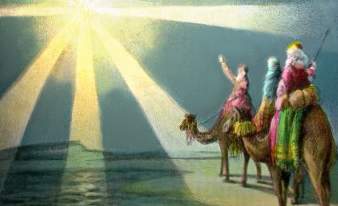
This art print,
"And Wise Men Came Bearing Gifts" by Tom duBois is provided courtesy of
Christ-Centered
Art"---New Window.
Other than the obvious and positive use of the phrase
"wise men" in the Old
Testament Scriptures, i.e., "He that walketh
with wise men shall be wise: but a companion of fools shall be
destroyed"(Proverbs 13:20), we find
that both the dynasties of the Egyptian pharaohs, i.e., "Then Pharaoh also called the wise men and the sorcerers:
now the magicians of Egypt, they also did in like manner with their
enchantments"(Exodus 7:11), and the
kingdoms of the Babylonian and Medo-Persian monarchs surrounded themselves with
"wise men." Originating
from the banks of the Tigris and Euphrates, the Magi were religious priests,
Chaldeans, physicians, philosophers, astronomers, astrologers, soothsayers, in
short, the brain trust of their kingdom. In ancient Babylon, which is now modern
Iraq, King Nebuchadnezzar dreamed of a great image, where he not only forgot his
dream but called upon his "wise
men" to interpret the vision on pain of death. "2Then the king commanded to call the magicians, and the astrologers, and
the sorcerers, and the Chaldeans, for to shew the king his dreams. So they came
and stood before the king. 3And the king said unto them, I have dreamed a dream, and my spirit was
troubled to know the dream. 4Then spake the Chaldeans to the king in Syriack, O king, live for ever:
tell thy servants the dream, and we will shew the interpretation. 5The king answered and said to the
Chaldeans, The thing is gone from me: if ye will not make known unto me the
dream, with the interpretation thereof, ye shall be cut in pieces, and your
houses shall be made a dunghill"(Daniel 2:2-5).
Naturally, the wise men objected to the impossible demand of the
king. "10The Chaldeans answered before the king, and said, There is
not a man upon the Earth that can shew the king's matter: therefore there is no
king, lord, nor ruler, that asked such things at any magician, or astrologer, or
Chaldean. 11And it is a
rare thing that the king requireth, and there is none other that can shew it
before the king, except the gods, whose dwelling is not with flesh"(Daniel 2:10-11). And, like an oriental despot,
Nebuchadnezzar "was angry and very furious,
and commanded to destroy all the wise men of Babylon" (2:12). Now, notice who the Divine Scriptures identify with the "wise men" of Babylonia. "And the decree went forth that the wise men should be
slain; and they sought Daniel and his fellows to be slain"(2:13). Yes, not only were Daniel and his companions
(Shadrach, Meshach, and Abednego) identified as "wise men," but, we are further informed that Daniel
was promoted to be the chief [Aramaic, rab ] among the "wise men" for successfully
interpreting Nebuchadnezzar's dream, i.e., "Then the king made Daniel a great man, and gave him many great gifts,
and made him ruler over the whole province of Babylon, and chief of the
governors over all the wise men of Babylon"(2:48). Later, Belshazzar was informed that Daniel, the
Master Magi of Babylon, was the only man that could interpret the famed
handwriting on the wall, "MENE, MENE, TEKEL,
UPHARSIN"(5:25). "There is a man in thy kingdom, in whom is the spirit of
the holy gods; and in the days of thy father light and understanding and wisdom,
like the wisdom of the gods, was found in him; whom the king Nebuchadnezzar thy
father, the king, I say, thy father, made master [Aramaic,
rab ] of the magicians, astrologers,
Chaldeans, and soothsayers"(5:11).
Certainly, the Almighty made a way for Daniel to avoid the
obvious pitfalls of the occult practices of the "wise men of Babylon," and He used the lawful
functions of Daniel's office to preserve the Seventy Weeks prophecy concerning
the First and Second Advents of Messiah the Prince. "24Seventy
weeks [490 prophetic years] are determined upon thy people [Israel] and upon thy holy city
[Jerusalem], to finish the transgression, and
to make an end of sins, and to make reconciliation for iniquity, and to bring in
Everlasting Righteousness, and to seal up the vision and prophecy, and to anoint
the most Holy [the Second Coming of Jesus
Christ].25Know therefore and understand, that
from the going forth of the commandment to restore and to build
Jerusalem [decree of Artaxerxes on March 14th 445 BC]
unto the Messiah the Prince [Triumphal Entry of Christ on April 6th 32 AD] shall be seven weeks, and threescore and two
weeks [7 + 60 + 2 = 69 (weeks) x 7 (of years) = 483
prophetic years]: the street shall be built
again, and the wall, even in troublous times. 26And after threescore and two weeks shall
Messiah be cut off [Crucifixion and Atonement of Jesus
Christ only a handful of days after the Triumphal Entry], but not for Himself: and the people of the prince that
shall come [Ancient Rome] shall destroy the city and the sanctuary [70
AD]; and the end thereof shall be with a
flood, and unto the end of the war desolations are determined. 27And he
[Antichrist] shall confirm the covenant with
many for one week [a shortly upcoming Tribulation Week of
seven years that obviously occurs after a more than 2,000 year gap between the
69th and 70th Week of Daniel]: and in the
midst of the week he shall cause the sacrifice and the oblation to
cease [the Abomination of Desolation in the Middle of the
Week], and for the overspreading of
abominations he shall make it desolate, even until the consummation, and that
determined shall be poured upon the desolate"(Daniel
9:24-27).
It is uncertain what the Magi of the Christmas
story identified as a star to cause them to set out for Jerusalem to see who the
Jewish Scriptures of Daniel would choose as the King of the Jews, but they knew
that Messiah the Prince would sit upon the throne of David. "Of the increase of His government and peace there shall
be no end, upon the throne of David, and upon His kingdom, to order it, and to
establish it with Judgment and with Justice from henceforth even for ever. The
zeal of the LORD of Hosts will perform this"(Isaiah
9:7). Since the Magi were able to calculate the time of the cutting
off of Messiah the Prince in Israel from Daniel's Seventy Weeks prophecy, they
needed a miraculous sign to indicate more precisely the time and place of the
birth of the Messiah, which the Almighty gladly provided by the Star of
Bethlehem. "We have seen His star in the East,
and are come to worship Him"(Matthew 2:2). Several things can be deduced from the Scriptural narrative of the
second chapter of the Gospel of Matthew concerning the Magi and the Star of
Bethlehem.
First, the two year period given to King Herod
represented the period during which the Wise Men first saw the Star of Bethlehem
until their conversation with Herod, and not indicating their time in transit
from the East nor necessarily the exact moment of the Saviour's birth;
therefore, the birth of Christ could have been as late as the autumn of 4 BC,
i.e., "7Then Herod, when he had privily called the Wise Men,
enquired of them diligently what time the Star appeared... 16Then Herod, when he saw that he was
mocked of the Wise Men, was exceeding wroth, and sent forth, and slew all the
children that were in Bethlehem, and in all the coasts thereof, from two years
old and under, according to the time which he had diligently enquired of the
Wise Men"(Matthew 2:7, 16).
Second, the astronomical phenomenon of the Star of
Bethlehem appears to be explained more as a miracle than as a momentary
conjunction of the planets of Jupiter and Saturn (6 BC) or
the brilliant but violent display of stellar light for a few months from a
supernova or the tail of Halley's Comet (11 BC);
additionally, the star un-astronomically traveled before the Magi, then stood
still, i.e., "When they had heard the king,
they departed; and, lo, the Star, which they saw in the East, went before them,
till it came and stood over where the Young Child was"(Matthew 2:9).
Third, Herod the Great did not have the Wise Men
followed because both he and the Wise Men were initially in agreement that the
exact whereabouts of the Young Child would be reported back to Herod; but, God
warned them "in a dream that they should not
return to Herod"(Matthew 2:12).
Fourth, though tradition identifies the Wise Men as
three-- Gaspar, Melchior and Belthazar-- because, most likely, they were
numbered by the three gifts of "gold [for a king],
and frankincense [a spice for priestly duties], and myrrh [an embalming ointment that
anticipated the Saviour's future death]"(Matthew 2:11), they were more
likely a larger entourage that could stir the interest of the city of Jerusalem,
i.e., "When Herod the king had heard these
things, he was troubled, and all Jerusalem with him"(Matthew 2:3).
Fifth, the Wise Men found the Young Child Jesus in a
Bethlehem house and not in a stable, indicating a later time than the nativity
seen by the shepherds in the second chapter of the Gospel of Luke, possibly only
a month later, i.e., "And when they were come
into the house, they saw the Young Child with Mary His mother, and fell down,
and worshipped Him"(Matthew 2:11).
Sixth, Joseph and Mary most probably had returned to
Bethlehem from the dedication of Jesus in the Temple at Jerusalem to complete
about a two month sojourn in Bethlehem before fleeing into Egypt and then
returning to Nazareth, i.e., "14When he arose, he took the Young Child
and his mother by night, and departed into Egypt: 15And was there until the death of
Herod [late in 4 BC]: that
it might be fulfilled which was spoken of the LORD by the prophet, saying, Out
of Egypt have I called My Son"(Matthew 2:14-15).
And finally, the Star of Bethlehem was not obvious to
those who were not aware of it to be looking and noticing, or Herod would have
already arrived at Bethlehem to kill his rival, i.e., "Herod will seek the Young Child to destroy Him"(Matthew 2:13).
Daniel's Seventy Weeks prophecy (Daniel 9:24-27) coupled with other Messianic prophecies, e.g., "The sceptre shall not depart from Judah, nor a lawgiver
from between his feet, until Shiloh come; and unto Him shall the gathering of
the people be" (Genesis 49:10), enabled these believing Magi
to greet their Newborn King with royal gifts, but they needed a special sign
from God in the form of the Star of Bethlehem, i.e., "there shall come a Star out of Jacob, and a Sceptre shall rise out of
Israel"(Numbers 24:17), to pinpoint the
birth of the Messiah at His First Advent. As much as Christians are rightly
warned about seeking after signs, i.e., a "wicked and adulterous generation seeketh after a sign; and there shall
no sign be given unto it"(Matthew 16:4)
and seeking to know the day and the hour of the coming of Jesus Christ, i.e.,
"ye know not when the time is"(Mark 13:33), both a sign and date will be
given for the Second Advent of Jesus Christ. The miraculous sign for the Second
Coming of Jesus Christ will be the Pre-Tribulational Rapture of the Watching and
Waiting Saints, i.e., "Watch ye therefore, and
pray always, that ye may be accounted worthy to escape all these things
that shall come to pass, and to stand before the Son of Man" (Luke
21:36), while the timing for the LORD's Appearing will be the
termination of the Seventieth Week of Daniel, i.e., "Seventy weeks are determined upon thy people and upon thy holy city, to
finish the transgression, and to make an end of sins, and to make reconciliation
for iniquity, and to bring in Everlasting Righteousness, and to seal up the
vision and prophecy, and to anoint the Most Holy"(Daniel 9:24). [See our articles, "Must There Be a Pre-Tribulational
Rapture?"---New
Window and "The
Seventy Weeks of Daniel"---New
Window, for more background on each of these prophetic themes.]
Like the Magi who looked for the appearing of the King of the
Jews, it is right that we look and wait expectantly for the soon return of the
KING of Kings. "So Christ was once offered to
bear the sins of many; and unto them that look for Him shall He appear the
second time without sin unto Salvation" (Hebrews 9:28). The
difference between those Magi of old who sought the Young Child of Bethlehem and
the contemporary seeker of Christ is that their sign was the Star of Bethlehem,
while our Pre-Tribulational Rapture will be a sign to those who are left behind,
who should have known better. "1Then shall the Kingdom of Heaven be
likened unto ten virgins, which took their lamps, and went forth to meet the
bridegroom. 2And five of
them were wise, and five were foolish. 3They that were foolish took their lamps, and took no oil
with them: 4but the wise
took oil in their vessels with their lamps. 5While the bridegroom tarried, they all slumbered and
slept.6And at midnight there was a cry made, Behold, the bridegroom cometh; go
ye out to meet him. 7Then
all those virgins arose, and trimmed their lamps. 8And the foolish said unto the wise, Give us of
your oil; for our lamps are gone out.9But the wise answered, saying, Not so; lest
there be not enough for us and you: but go ye rather to them that sell, and buy
for yourselves.10And while they went to buy, the bridegroom came; and they
that were ready went in with him to the marriage: and the door was
shut.11Afterward came also the other virgins, saying, LORD, LORD, open to us.
12But he answered and
said, Verily I say unto you, I know you not. 13Watch therefore, for ye know neither the day nor the hour
wherein the Son of Man cometh"(Matthew 25:1-13). [See our article, "A Tale of Ten Virgins" ---New Window, for greater understanding of
Christ's parable and the Pre-Tribulational Rapture.]
May God
grant to us the grace to shine as the Star of Bethlehem, and may the
"LORD direct your hearts into the love of God,
and into the patient waiting for Christ"(2Thessalonians 3:5).
Maranatha!
[See our article, "The
Glory and Majesty of Christmas" ---New
Window, for more background on the Christmas story. And, Sir Robert
Anderson's "The Coming
Prince" ---New Window(1895)
provides a scholarly and faith-filled defense of Daniel's Seventy Weeks prophecy
(Daniel 9:24-27) of the First and Second Advent of Messiah
the Prince, giving justification for many of the dates employed in this
presentation. Also, "Sir Robert Anderson
and the Seventy Weeks of Daniel" ---New
Window gives background on Sir Robert Anderson, a stalwart defender
of the "faith which was once delivered unto the
Saints"(Jude 3).]
Greater strength and endurance. Enhanced thinking. Better teamwork. New classes of genetic weaponry, able to subvert DNA. Not long from now, the technology could exist to routinely enhance — and undermine — people’s minds and bodies using a wide range of chemical, neurological, genetic and behavioral techniques.
It’s warfare waged at the evolutionary level. And it’s coming sooner than many people think. According to the futurists at the U.S. National Intelligence Council, by 2030, “neuro-enhancements could provide superior memory recall or speed of thought. Brain-machine interfaces could provide ‘superhuman‘ abilities, enhancing strength and speed, as well as providing functions not previously available.”
Qualities that today must be honed by years of training and education could be installed in a relative instant by, say, an injection or a targeted burst of electricity to the brain. Rapid advancements in neurology, pharmacology and genetics could soon make such installations fairly easy.
These modifications could give rise to new breeds of biologically enhanced troops possessing what one expert in the field calls “mutant powers.” But those troops may not American. So far, the U.S. military has been extremely reluctant to embrace human biological modification, or “biomods.” And that could result in a veritable mutant gap. In this new form of biological warfare, the U.S. could find itself outgunned.
But not if Andrew Herr can help it.
A 29-year-old Georgetown-trained researcher with degrees in microbiology, health physics and national security, Herr is one a handful of specialists in the defense community preaching greater U.S. investment in biomods. First as a consultant with the Scitor Corporation, a Virginia-based firm whose clients include top military and intelligence agencies, and later as the head of his own research organization, Herr’s job has been to think about biological modifications whose effects he says are “more than evolutionary.”
Another word for that: revolutionary.
Whether positive or negative, the impact of routine biomods could be huge. “The best-case scenario is extraordinary increases in quality of life in the First World and beyond,” Herr says. The worst-case scenario, he adds, is people being biologically modified “without them knowing it.” That is, an evolutionary sneak attack.
Nicely done brief history of the growing tyranny of the central banks, run by a small group of families. It points out real heroes of the past (like Andrew Jackson) and real villains (like Woodrow Wilson). It also reminds us that groups that insist on working in the dark (the Federal Reserve, the private bank that prints and gives away U.S. money) are linked through history with assassins, blackmail and any possible means of gaining power.
Lest the bankers think they can and will "win", judgment awaits all men. And the judgment of those who have wrought such villainy will be fierce.
December 27, 2012 – MANAGUA, Nicaragua(AP) — Nicaraguan authorities say they’ve ordered the evacuation of some 300 families living on the flanks of the country’s highest volcano after it began spewing hot gas and ash Tuesday. Some 1,500 farmers living on the slopes of the San Cristobal volcano refused to leave, despite being ordered to evacuate as the volcano spewed gas, sand and ash.
“People have not evacuated because we do not want to go and leave the area abandoned,” Maria Pereira told AFP. Pereira lives in “Grecia 4,” a community of about 600 people at the base of the volcano, in the Chinandega department.
She said columns of ash “bathed the trees, houses, and roads in white” and “pretty sand fell” in the morning. She said by early afternoon volcanic activity had decreased, though in the evening new columns of ash shot up.
In another community near the volcano, Bethlehem, some farmers resisted efforts of Civil Defence officials to convince them to obey the evacuation order.
Federal government spokeswoman and first lady Rosario Murillo told a local radio station that a yellow alert was declared Wednesday in a 1.8-mile radius around the San Cristobal volcano to allow the evacuation of residents who would be at highest risk during a significant eruption. Murillo said 15 eruptions had been recorded over the last day at the volcano northeast of the capital of Managua. She said the volcano has emitted regular small eruptions, but larger ones are unpredictable. Authorities had wanted to move the closest residents away from the volcano as a precaution.
This isn't reallly new, so it's not technically "news", but many aren't aware of the push for "global governance" (a single global governing body determining law for all nations). So, time to wake up...
Good King Wenceslaus went out On the Feast of Stephen, When the snow lay round about Deep and crisp and even.
O.K., Christians of the world: Church history for one hundred. When is the Feast of Stephen and to whom does it refer? (Pause for hemming and hawing.)
It's December 26, the day after Christmas, when the death of the church's first martyr, Stephen, is traditionally commemorated. Trivial, yes, but most Christians can't give me the correct answer.
My preoccupation with this began a year ago, when I found myself sitting in an evangelical church in early December listening to the singing of Christmas carols. "Could the church have lost its mind?" I thought. It has become so much like the world.
In the ancient church, Christmas was celebrated on... Christmas. Everything prior to that was a preparation for the big day but Christmas itself wasn't celebrated until midnight, December 24th, when the Christ child was welcomed into the world.
Christ wasn't actually born on December 25th. The actual date is a subject of debate. But in 336 a.d. the church set the date at December 25th (Julian calendar) to offset the pagan celebration of the winter solstice at the Saturnalia, much as churches today have "harvest parties" to offset what is becoming an increasingly occult Halloween.
Following the time of the apostles, the early church began to develop organization and worship in five major centers around the Mediterranean: Jerusalem (naturally), Antioch, Alexandria, Constantinople and Rome.
Just as the Jewish calendar had an annual series of liturgically rotating feasts that God ordained in the Old Testament, so the form of worship in the early churches rapidly developed into a liturgical calendar centering around the Lord's Supper, which originally they all shared in one form or another.
Distance caused the different liturgies to diverge in the selection of prayers, requirements and customs, but after the Great Schism between the Roman and Orthodox churches in 1054, the liturgical form of worship was still retained. The western church followed the Roman rite (the Mass) and the Orthodox churches followed the liturgy of St. John Chrysostom. Both still today have major portions of their rites in common.
The Roman church developed a hierarchical structure centered around the papacy and the bishops. The Orthodox churches developed a more networked approach, centering around the bishops, all of whom were in affiliation with each other in what were called autocephalos or independent churches, who reported to a Metropolitan.
During the Reformation, the Lutheran church retained the form of the Roman liturgy and much of the church structure but corrected what it believed were non-Biblical errors that had crept into the Roman church over the centuries. The Anglican church likewise retained the church structure and worship.
Other Christian groups opted to throw out all of it in favor of different, more simplistic and often stark forms of worship. In retrospect, they may have thrown out the baby with the bath water, retaining only key dates such as Christmas, Easter and possibly Pentecost. Some introduced a few new ones, such as Reformation Sunday.
In trying to counter the secularization of its holy days, the church is having a difficult time because it has forgotten the origins of its celebrations.
Advent
In western churches the four Sundays prior to Christmas were called Advent, coming from the Latin verb advenire, meaning "to come towards."
The church was decorated in purple, along with the priest who wore the same color, signifying penance. Prior to December 25th, the church was in a period of penance, preparation and anticipation of the Messiah's birth. Fasting was observed several times a week. All of the hymns and prayers reflected this repentance and preparation; a period of darkness into which the Lumen Christi (the light of Christ) must come.
Scripture readings from the Old Testament and the Gospels matched the season, such as the Old Testament prophecies about the Messiah and Gospel passages about the ministry of John the Baptist preparing the way for Christ.
Hymns included "On Jordan's Bank the Baptists Cry" and "O Come Immanuel" but never a Christmas carol. Christ had not yet arrived.
Then Cometh Christ's Mass
For centuries the Midnight Mass on Christmas Eve was a radical change from the previous four weeks"this liturgical text became the centerpiece of a number of Baroque and classical compositions.
Christmas itself means Christ's Mass"the mass celebrated on Christmas Day. The church was decorated and ablaze with lights. Colors had shifted from purple to gold and white and the traditional green/red themes. Much incense was used. Christ had finally come. This was a time of great celebration, and hence the use of the word "feast" to designate the day.
Other Christmas Traditions
The Middle Ages saw the beginnings of liturgical dramas (often called "mystery plays") designed to portray Biblical stories surrounding Christmas. Recall that the majority of the population of Europe at the time was illiterate and so the mystery plays provided a method of teaching Biblical things. Over the centuries the mystery dramas started to become profane and secular in nature (sound familiar?) and so performances in churches were eventually banned.
Also, manger scenes (or creches as they were called in French) began to appear, and it was a Christmas custom for every family to visit the crche.
The Advent Wreath
The custom of the Advent wreath evolved in northern Europe. The wreath has four candles: three purple and one pink. In some cases, three red and one white candle are used.
One candle is lit on each Sunday of Advent at dinner time and the family sings "O Come Immanuel" prior to the blessing. The third Sunday of Advent is a different color, signifying that while we are still in darkness, there is hope and the light of Christ is coming.
In the western church it was called Gaudate (gow-day-tay) Sunday, meaning we should rejoice, for there is hope.
In America, the tradition has started of adding a white candle in the center on Christmas Day to signify that the light of Christ has come into the world.
Some Lutheran churches reverse the Advent wreath process, using a ring of candles, one for each Sunday of Lent prior to Holy Week. Sunday after Sunday one less candle is lit until finally, on Good Friday, the center Christ candle is extinguished.
There are as many Christmas traditions as there are countries and centuries. Many had strictly Christian origins. Others are a mix of vestiges of pagan custom adapted into Christianity. This, and the observance of Christmas itself, has been the source of much debate, which is not the subject of this article.
The Twelve Days of Christmas
The Twelve Days of Christmas ranks as part of the regular Christmas carol fare. So what are they? They are the days when Christmas was traditionally observed, between December 25th and January 6th. January 6th was the Feast of the Epiphany, when the three Wise Men finally arrived, thus the twelve days when Christmas was celebrated.
In some places presents were given each day of the twelve days instead of tearing into a big wallop of presents on December 25th. Traditionally the Christmas tree went up on December 24th in the evening and came down on January 6th.
The Feast of the Holy Innocents is celebrated on December 28th, commemorating the children who were killed in Bethlehem as Herod sought to destroy the child Jesus.
Santa Claus
Santa Claus means Holy Claus, short for Nicholas. The word "santo" is "holy" in Latin as well as its descendent tongues, such as Spanish and Italian. According to the Encyclopaedia Britannica, St. Nicholas was born in the ancient city of Patara. As a youth he traveled to Palestine and later became Bishop of Myra. He was imprisoned during the persecution of Christians under Emperor Diocletian and was later attendant at the First Council of Nicea in 325 a.d.
Legend says that he showed unusual kindness to the poor and the weak; oftentimes leaving things for them while they were asleep. In the Middle Ages he became patron saint of charitable fraternities, children, and other things as well as patron saint of the City of Moscow, Russia. After the Reformation, the legend of St. Nicholas died out everywhere except in Holland. It migrated to the U.S. with Dutch Reformed Christians.
St. Nicholas's red outfit was derived from the red colors bishops wore. The modern version of St. Nick originated in a series of Thomas Nast engravings, which appeared in Harper's Weekly between 1863 and 1886.1 Other Traditions
The Night before Christmas was first published in 1822 and picked up widespread popularity and republishing. During Queen Victoria's reign in England, tree decorating was well under way. Martin Luther is reported to have been the first person to actually put lights on a Christmas tree. (One can only speculate whose house was the first to burn down as the result of a Christmas tree.)
In 1880, Woolworth's first sold manufactured Christmas tree ornaments and they caught on very quickly.2
In Mexico and southern parts of the United States, Las Posadas has been a major tradition, which is now spreading in popularity. Las Posadas sees children going door to door asking for shelter, just as Joseph and Mary did when Mary was about to give birth to Jesus. The answer from the person who answers is always a negative head shake and the response, "no posada" (no shelter). Candles placed in paper bags (luminarias) serve as chains of lanterns on the ground leading up to the doors to show the expectant couple the way.
Rudolph, the genetically mutant reindeer, is a latecomer and has absolutely no religious significance whatsoever. In 1939, Santas at Montgomery Wards gave away 2.4 million copies of a booklet called "Rudolph the Red-Nosed Reindeer." 3 It was written by Robert May, an advertising executive in the store. In 1949, western singer Gene Autrey did a musical rendition of the poem and it became an overnight best-seller.
Christians today tend to fight the ongoing secularization of their holidays. Some have rejected anything to do with them, saying they are not Biblically ordained. Others have tried to go back to keeping the Jewish feasts instead. It should be pointed out that the New Testament doesn't really ordain anything other than the Lord's Supper. But it does not prohibit it either, and under grace Christians are free to honor different days if they wish. Those families who want to keep Christ as the center of Christmas may find it easier to do by understanding the various symbols that have been used to celebrate Christ's birth through the ages and using them to retain the uniqueness inherent in the mystery of the incarnation: the birth of the Son of God.
December 25, 2012– CLIMATE – From deadly cold in Russia, floods in Britain and balmy conditions that have residents in southwest France rummaging for their bathing suits, the weather has gone haywire across Europe in the days leading up to Christmas. The mercury in Moscow has fallen to minus 25 degrees Celsius (minus 13 degrees Fahrenheit) — unseasonably cold in a country where such chills don’t normally arrive until January or February. The cold has claimed 90 lives in Russia since mid-December and 83 in Ukraine, with eastern Eurasia in the grips of an unusually icy month that has seen temperatures drop to as low as minus 50 degrees C in eastern Siberia. Another 57 people have died from the cold in Poland this month, and officials say the icy front is probably “the most severe of the last 70 years,” according to Regis Crepet, a forecaster with Meteo-Consult.
While the former Eastern bloc shivers and Britain fights severe flooding after heavy rains, holiday-makers and residents in the south of France and in Italy have dug out their shorts and swimwear to welcome an unexpected blast of beach weather. Temperatures on Sunday climbed to 24.3 degrees C in Biarritz on the Atlantic coast, nearly 12 degrees hotter than the seasonal average, and nudging the 1983 record of 24.4 degrees C. “These are remarkable temperatures that we do not see every year,” French weather forecaster Patrick Galois said. In Catania on Italy’s Sicily coast, beach temperatures on Christmas day are forecast to climb as high as 22 degrees C in some places, while in Austria, the small village of Brand at an altitude of more than 1,000 meters (3,200 feet), noted a December 24 record of 17.7 degrees.
C. Jim Palmer, professor of climate physics at Oxford University, told AFP the weather extremes are explained by the northern hemisphere “jet stream,” a ribbon of air that speeds around the planet high up in the atmosphere. The stream is akin to a length of rope “that you wiggle a bit,” said Palmer — its undulations differing from year to year. This winter the jet stream is particularly wavy, pulling cold air in over Russia from the far north, and bringing hotter air up from the south over France and its neighbors. “The question: Is the waviness and the unusual configuration of the jet stream the result of climate change? We don’t know. The models are probably not quite good enough to tell us,” said Palmer, though there was “some evidence” this may be the case. -TD
Senator Paul points out in this video that freedom in America is temporary, or perhaps just an illusion. We should have known when we lost control of our air quality (daily chem-sprays), our water quality (fluoridation and more), and economy (the federal reserve). It's just a matter of time before personal freedoms are also lost...
The music is from the second chorus of a contata by Felix Mendelssohn
(1809-1847) written in 1840 to commemorate Johann Gutenberg and the invention of
printing. The words are from a hundred years earlier, written in 1739 by Charles
Wesley whose brother, John, founded the Methodist Church. "Hark, how the welkin
(heaven) rings," he orginally wrote.
A colleague, the Calvinist Whitefield, substituted the familiar
opening line over the protests of the author. In 1855, after both Wesley and
Mendelssohn were dead, Dr. William Cummings put the words and music together in
spite of evidence that neither author nor composer would have approved.
[Quiz note: Mendelssohn had
made it clear that his music was for secular use, and Wesley had specifically
requested slow solemn music for his words.]
Luke 2:22-35 "And when the days of her
purification according to the law of Moses were accomplished, they brought him
to Jerusalem, to present him to the Lord; [23] (As it is written in the law of
the Lord, Every male that openeth the womb shall be called holy to the Lord;)
[24] And to offer a sacrifice according to that which is said in the law of the
Lord, A pair of turtledoves, or two young pigeons. [25] And, behold, there was a
man in Jerusalem, whose name was Simeon; and the same man was just and devout,
waiting for the consolation of Israel: and the Holy Ghost was upon him. [26] And
it was revealed unto him by the Holy Ghost, that he should not see death, before
he had seen the Lord's Christ. [27] And he came by the Spirit into the temple:
and when the parents brought in the child Jesus, to do for him after the custom
of the law, [28] Then took he him up in his arms, and blessed God, and said,
[29] Lord, now lettest thou thy servant depart in peace, according to thy word:
[30] For mine eyes have seen thy salvation, [31] Which thou hast prepared before
the face of all people; [32] A light to lighten the Gentiles, and the glory of
thy people Israel. [33] And Joseph and his mother marveled at those things which
were spoken of him. [34] And Simeon blessed them, and said unto Mary his mother,
Behold, this child is set for the fall and rising again of many in Israel; and
for a sign which shall be spoken against; [35] (Yea, a sword shall pierce
through thy own soul also,) that the thoughts of many hearts may be
revealed."How committed are you to God? This is the
first question I feel God laying on my heart this morning, to ask each and every
one of us to examine our commitment, our dedication, to the Creator of all life.
This is a fair question. In our modern day commitment is often measured in
years, days, or even hours - yet God expects more than a shallow commitment from
each one of us. He expects our all - the best loyalty we can show to He who died
for us. Commitment.Remember last week we discussed Jesus'
birth, how He was born in a lowly manger, a place for feeding the animals. As
the Christmas season is still upon us, I'm certain we'll go back and examine
other events that happened at the time of that beautiful and glorious Birth.
Yet, today, we're going to look at an event that occurred in the life of the
infant Jesus, and we're going to look at commitment.As our story opens we see that Mary and
Joseph were committed to their God. According to Jewish law a woman, even Mary,
became ceremonially unclean on the birth of a child. Eight days
after the birth the baby was circumcised (Genesis 17.12), and after this
circumcision the mother was considered unclean for another 33 days (Leviticus
12.1-5) - a total of 41 days from the birth. Following this 41 day period the
mother offered a sacrifice at the Temple: a lamb if the parents were well off,
two doves or young pigeons if they were poor. Note:
Luke 2.24 "And to offer a sacrifice
according to that which is said in the law of the Lord, A pair of turtledoves,
or two young pigeons."Mary and Joseph were not well off.
In fact, they were poor, and offered the two doves, a poor offering, in homage
to God. In our modern times we have heard people blame their lack of interest in
God because of their poverty, or because they "are too busy earning a living",
but Mary and Joseph were committed to their God.If anyone had a good reason to ignore God,
Mary and Joseph had one. When Jesus was born, Joseph had to endure the
humiliation of watching the woman he loved bear a child in a filthy stable. Mary
had to endure the humiliation of bearing the child by herself then, after the
birth, wrapping her child in rags and laying him in a manger. Many of us would
have shook our fists heavenward, angry with God that we were in such a terrible
predicament. Many among men would have cursed God, and abandoned His Church.
After all, I'm a good person - I don't deserve such treatment. It's not fair!
It's not fair!!The other day I met a woman who used to be
a faithful member of the Church - not this Church, but another I attended. A
fight broke out in the Church, and the Pastor was pushed aside by the conflict.
The woman left the Church, and when I saw her she said that she hasn't been in
Church for some time, she's stopped seeking, her faith is weak and all but gone.
And with sadness in my heart I realized that, perhaps, she had never really put
her trust in Christ. She had never really believed in that baby in the manger,
but she put her faith in the Pastor, and in the Church. She put her belief in
the Pastor, the Church, but not in the One who has the power of life over death.
How tragic!For when we place our trust in the Church,
the Pastor, our environment, or in our riches, we often miss out on the blessing
of Christmas. We make the promises of God naught when we misdirect our
faith.Mary and Joseph refused to misdirect their
faith. Sure, their situation was lousy. Brothers and Sisters, life is often
lousy! The devil throws up as many barriers as he can to try and get you to
stumble. If you have accepted Jesus, the Reason for the Season, then you are
not a friend of the world. The world hates you, your family
misunderstands you, and you may have kin who think you're a "fanatic". Mary and
Joseph ignored their situation and went to the Temple anyway to do as God asked.
And you know what?
They Were Blessed By
Simeon!
We don't know who Simeon was. Some people
think he was a priest, but the truth is, we don't know anymore about him than
what these Scriptures tell us here. We do know this: Simeon was a man who loved
God deeply, so much so that God was able to use him in a magnificent way. When
Mary and Joseph came across this old man, he prophesied one of the greatest
sermons of all time - the events and fate of the Messiah's life. Look at
Simeon's character:
Luke 2.25 "And, behold, there was a man
in Jerusalem, whose name was Simeon; and the same man was just and devout,
waiting for the consolation of Israel: and the Holy Ghost was upon
him."1. Simeon was just and devout. "Just", the Greek DIKAIOS, means
that he was a righteous man, living as God asked him to live. "Devout", EULABES, means that Simeon
was cautious and careful in his relationship with God. He was never flippant
with his Creator, but knew God for what He is - the Sovereign King of all. In
other words, Simeon was committed in his personal life to God, and kept his eyes
"on the Cross" that was ever before him. This is the type of person God looks
for, the person who is willing to serve Him at all costs.We do not know if Simeon was rich or poor,
well dressed or in rags. The only thing we know is that, no matter what his
state, he was single-mindedly "waiting for the
consolation of Israel". He knew that the Messiah
was coming, because God told him he would not see death until he saw the
Messiah. So Simeon focused on this, and waited day after day at the Temple. He
knew Messiah would have to come to the Temple, because he knew Messiah would be
of the throne of David, the God-Man, and knew that Messiah's guardians would
bring Him to be dedicated. So he waited, and watched, waited, and watched. Each
child that was brought to the Temple, Simeon would go over and look the child
over to see if he was Messiah. Day after day Simeon looked over children and
came away unsatisfied, yet each new day he came back and looked
again.If you desire Jesus' presence, then weep
after it! If you desire Jesus' presence in our services, come looking for
Him! If we live our lives like Simeon, looking for the Christ, living devotedly
to Him, serving - YES SERVING Him in this assembly, then we cannot help but find
Him. Though we be in poverty, He will be more real than the weekly paycheck.
Though we be in pain, He will be more real than the pain killer, more real than
the doctors. Though we suffer loss, and the devil try to shake us, Jesus will be
our anchor - but we must open our hearts to His presence, not to
despair.
The Army lieutenant stood up from his bench, straightened his
uniform, and studied the crowd of people going through Grand Central Station. He
looked for a girl that he loved, but had never seen her face. Many months before
he found her address in a library book, wrote her to conquer his loneliness, and
she, surprisingly, replied.
The lieutenant went off to serve his country in World War II,
and for thirteen months they corresponded while he was overseas. As they wrote
back and forth, they began to fall in love with one another. He wrote and asked
her for a photograph, and she wrote back, "No. If you love me, you won't care
what I look like". So they continued corresponding, and their love grew.When the lieutenant was to return stateside, he asked that she
meet him in the Grand Central Station in New York. She agreed, and said that he
would recognize her by the rose she wore. So the lieutenant looked - and saw the
most beautiful woman he had ever seen in a green suit. As he started toward her,
he stopped, for behind her he saw a woman wearing a red, red rose.The woman with the rose was well past 50 years old, plump, with
thick ankles shoved into low heeled shoes. Her gray hair was tucked under a
floppy, worn hat. The woman in the green suit walked away, and the young man
nearly followed her. Here he was confronted with a choice, the young woman, or
the old, spinster. Yet as he thought about it, the letters they had written to
each other jumped out in his mind. He squared his shoulders, walked up to the
older woman, and said, "I'm lieutenant John Blanchard. You must be Miss Maynell.
I'm so glad to meet you, could I take you to dinner?"The woman's face lit up, and she said, "I don't know what this
is about, son, but the young lady in the green suit who just walked past asked
me to wear this rose. I was supposed to tell you, if you came up, that she is
waiting for you in the restaurant across the street. She said, this was a kind
of test!"
So many people fail the test. Joseph and
Mary could have failed the test by dwelling on their poverty, and thus missed
the blessing waiting for them at the Temple. Simeon could have become
disheartened by waiting, and missed coming to the Temple the day Jesus came. Yet
all three retained their commitment to God, and because of this were blessed
beyond measure.
Simeon's Song - Nunc
Dimittis
Suddenly, Mary and Joseph's faithfulness
and Simeon's devotion came together in the Temple, and the end result was song.
Yes, Simeon's prophecy was proceeded by a song of thanksgiving called "Nunc
Dimittis", after the first words of this text in the Latin
Vulgate:Luke 2.29-32 "Lord, now lettest thou thy
servant depart in peace, according to thy word: [30] For mine eyes have seen thy
salvation, [31] Which thou hast prepared before the face of all people; [32] A
light to lighten the Gentiles, and the glory of thy people
Israel."Look how different these words are from
those who have not embraced Christ. Simeon saw the Christ Child, picked Him up,
held Him to His breast (verse 28 "Then took he him
up in his arms, and blessed God ...), just as he
had held Him to his heart for oh so very long. When he embraced the Christ to
himself, all the cares of this world dropped away. He had seen, touched, hugged
the "salvation" of
God, the Source of peace for the whole world. He praised God for fulfilling His
promise "according to thy word". God promised, Simeon believed, and when the promise was
fulfilled it was more than he had hoped for - so much more, that he could not
help but break out into song! When this Child later grew to be a man He would
say:John 14:27 "Peace I leave with you, my
peace I give unto you: not as the world giveth, give I unto you. Let not your
heart be troubled, neither let it be afraid."andJohn 16:33 "These things I have spoken
unto you, that in me ye might have peace. In the world ye shall have
tribulation: but be of good cheer; I have overcome the world."There is peace in trusting the promises of
God. Peace in accepting Jesus Christ, embracing Him to your breast, accepting
Him into your heart. The peace that Jesus brings is not for any one nation or
group of people, but for all people. There are Churches in America, perhaps in
our area, that have divided because "the wrong sort of people" came in. By this
they mean the wrong color of skin. Yet Jesus came as "A light to lighten the Gentiles, and the glory of thy people
Israel", a light for all men and women. Jesus
Christ would break the racial barriers that men erected, dying on the Cross for
all people. Paying the penalty for any who would receive Him, regardless of
color or status.
Faith in the Church will not save you, nor
will faith in the Pastor, a religious speaker, a system, or even in Billy
Graham. Your faith must be in that Child, born poor, born in a stable and laid
in a manger. Christ can either be a foundation for your life, or a stumbling
block:1 Peter 2:7-8 "Unto you therefore which
believe he is precious: but unto them which be disobedient, the stone which the
builders disallowed, the same is made the head of the corner, [8] And a stone
of stumbling, and a rock of offense, even to them which stumble at the word,
being disobedient: whereunto also they were appointed."Jesus Christ demands that every man
make a choice, demands that you make a choice today. You can reject the
Messiah because of your circumstances, the trials of your life, because of your
environment, and fall over that Stone as you find something to believe in other
than Him. Or you can accept the Savior, the Christ Child, and rise to eternal
life with Him as the cornerstone of your life.
Simeon's
Prophecy
Luke 2.34-35 "And Simeon blessed them,
and said unto Mary his mother, Behold, this child is set for the fall and rising
again of many in Israel; and for a sign which shall be spoken against; [35]
(Yea, a sword shall pierce through thy own soul also,) that the thoughts of many
hearts may be revealed."Simeon told Mary and Joseph that the
Child's fate was sealed. He was "a sign which
shall be spoken against", and would minister from
age 30 to 33, blessing everyone He came in contact with. Christ was a sign of
God's love and punishment, a sign that would cause men to react. Men want a god
that allows them to live as they desire, not a God who demands obedience and
self sacrifice. They want a god of license, not One of demanding
Love.I am sure that Mary remembered these words
when her child was nailed to the tree, when He was spat on and cursed. On that
day "a sword"
pierced through her soul as she watched her child, the baby in the manger, the
child of her youth, pour out His lifeblood for all mankind.
Have you embraced that Baby? Do you know
Jesus?
A man named Rudd told what it was like to live at the North
Pole during three months of darkness. "You never see the sun", he said, "I ached
and hungered to see the dawn". Then one morning in February he climbed atop a
wind swept ridge and sat quietly, facing east. The sky was a gray sheet. Then it
became a pale blue, which deepened. There was a silent rush of color as the sun
rose. Rudd sat blinking with frozen tears on his
cheeks.
Man hungers for the Son to rise! Let Jesus
arise in your hearts today!1 Corinthians 1:18 "For the preaching
of the cross is to them that perish foolishness; but unto us which are saved it
is the power of God."
Christianity faces being wiped out of the “biblical heartlands” in the
Middle East because of mounting persecution of worshippers, according to a new
report.
The most common threat to
Christians abroad is militant IslamPhoto:
ALAMY
The study warns that Christians suffer greater hostility across the world
than any other religious group.
And it claims politicians have been “blind” to the extent of violence faced
by Christians in Africa, Asia and the Middle East.
The most common threat to Christians abroad is militant Islam, it says,
claiming that oppression in Muslim countries is often ignored because of a fear
that criticism will be seen as “racism”.
It warns that converts from Islam face being killed in Saudi Arabia,
Mauritania and Iran and risk severe legal penalties in other countries across
the Middle East.
The report, by the think tank Civitas, says: “It is generally accepted that
many faith-based groups face discrimination or persecution to some degree.
December 24, 2012 – CLIMATE- An outbreak of severe weather, including tornadoes, threatens to ruin Christmas Day for families and communities across the Gulf Coast states. The area at greatest risk for damaging thunderstorms and tornadoes on Christmas Day stretches from southeastern Texas to the Florida Panhandle and southwestern Georgia. That zone is home to College Station and Houston, Texas, Lafayette, Baton Rouge and New Orleans, La., Jackson and Gulfport, Miss., Montgomery and Mobile, Ala., Pensacola, Fla., and Albany, Ga.
AccuWeather.com meteorologists are especially concerned for the potential for loss of life with this outbreak since it will actually commence during the predawn hours of Christmas across southeastern Texas. Tornadoes touching down during the nighttime hours is always a dangerous situation as people may sleep through vital warnings or have difficulty seeing an approaching twister. The severe weather danger will then expand eastward on Christmas Day, encompassing central and southern Louisiana, the southern half of Mississippi and Alabama and southwestern Georgia and the Florida Panhandle.
In addition to tornadoes causing destruction, severe thunderstorms capable of unleashing damaging winds and flooding rain are a serious concern. The violent thunderstorms should organize into a solid line by Tuesday night and march across Alabama, northern Florida and Georgia with damaging winds. The severe weather danger should reach the Southeast coast, from eastern North Carolina to northeastern Florida, on Wednesday. Wilmington, N.C., Charleston, S.C., Savannah, Ga., and Jacksonville, Fla., are among the communities at risk this day. The same storm set to trigger the impending severe weather outbreak will also spread a swath of significant snow from the southern Plains to the eastern Great Lakes and Northeast from Christmas Day to Thursday. Ahead of this storm, another system is triggering showers and thunderstorms across the South today. Thunderstorms causing damage this Christmas Eve would be extremely isolated occurrences, but the danger of lightning striking anyone spending the day outdoors still exists. -Accuweather




 A colleague, the Calvinist Whitefield, substituted the familiar
opening line over the protests of the author. In 1855, after both Wesley and
Mendelssohn were dead, Dr. William Cummings put the words and music together in
spite of evidence that neither author nor composer would have approved.


