Showing posts with label Ancient Archaeology. Show all posts

May 10, 2015

Bob Cornuke - The True Location of the Temple in Jerusalem

If you haven't gotten the book "Temple" by Robert Cornuke, I highly recommend it.  The research in terms of scriptural connections and detective work as well as on the ground detective work is excellent, and I think the location may have a huge influence on a coming third temple in Jerusalem.  Good stuff....

Visit our blog: http://www.shofar-ministries.blogspot...
Is the Temple Mount the true location of Solomon's and Herod's Temple? Listen to the amazing interview with Bob Cornuke as he details discoveries pointing to the true location being 1,000 feet south of the Mount in the City of David. Visit us at: http://www.shofar-ministries.blogspot... and visit Bob Cornuke at http://www.baseinstitute.org

May 5, 2015

Liquid Mercury Found at Teotihuacan's Pyramid of the Serpent

Fascinating stuff, as history in the last century has connected governments like Germany connecting ancient technology involving liquid mercury to "godlike" flying machines....and not it's found at one of the world's greatest monuments, and one made to honor the great serpent no less...

by

his story was sent by so many of you that it bears some commentary. My problem in commenting about it, however, was which version of this story to select. But these two, from the UK's The Guadian and the USA's Newsweek will do as well as any:


Liquid mercury found under Mexican pyramid could lead to king's tomb

Liquid Mercury Found in Mexican Pyramid Could Hold Secrets of Teotihuacan

There are a number of curious - and predictable - feastures of this story, which for our purposes we shall focus on The Guardian's presentation. The first, and most obvious, is the standard temptation to explain the unusual presence of mercury at the Pyramid of the Serpent in terms of the usual line that this was all about royal funery arrangements and "religion":
"Gómez speculated to Reuters that the mercury could be a sign that his team is close to uncovering the first royal tomb ever found in Teotihuacan after decades of excavation – and centuries of mystery surrounding the leadership of the cryptic but well-preserved city.
"The mercury may have symbolized an underworld river or lake, Gómez postulated, an idea that resonated with Annabeth Headreck, a professor at the University of Denver and the author of works on Teotihuacan and Mesoamerican art.
"The shimmering, reflective qualities of liquid mercury may have resembled “an underworld river, not that different from the river Styx,” Headrick said, “if only in the concept that it’s the entrance to the supernatural world and the entrance to the underworld.”
“'Mirrors were considered a way to look into the supernatural world, they were a way to divine what might happen in the future,' she said. 'It could be a sort of river, albeit a pretty spectacular one.'
"Joyce said that archaeologists know that scintillation fascinated the ancient people generally, and that the liquid mercury may have been regarded as 'somewhat magical … there for ritual purposes or symbolic purposes.'
"Headrick said that mercury was not the only object of fascination: 'a lot of ritual objects were made reflective with mica,' a sparkling mineral likely imported to the region."
Except, there's something of a fly in the ointment, or rather, perhaps a whole lot of flies, and that is simply that no recovery of a "royal tomb" has yet been discovered "after decades of excavation." In other words, in site of all the archaeological theory about rituals and mirrors and divination, the key piece of evidence that would confirm these ideas is utterly missing. It's rather like that inconvenient fact that no "king" or "queen" was ever found in the "King's Chamber" and "Queen's chamber" in the Great Pyramid. Indeed, the names of those interior structures inside the Great Pyramid were chosen in deference to the reigning archaeological theory. It was a convenient way of stamping the theory onto the structure in the absence of evidence to support it.

Now, I'm not saying for a moment that no tomb can or ever will be found under any of the pyramids of Teotihuacan. What I am saying is that one cannot rush to the decision that if such a discovery was made, that it would be contemporaneous to the civiliation that actually constructed the monuments (if monuments they were). Only careful dating of such a discovery, coupled with close argumentation, could establish this.

What disturbs me here, as it probably disturbed the many people who sent me various versions of this story, is the rush to impose the "standard" view of archaeology that the discovery of mercury, like mica, at Teotihuacan must have something to do with the primitive and mildly entertaining superstitutions of the "backward" people that built the site. What is nowhere entertained is the idea that the presence of such elements might indicate something far different about the structures, namely, that they may have been constructed as some sort of machine. Mercury is well known, of course, as a principal element in alchemical experiments. But it is also useful for experiments in plasmas, and a variety of other uses. Mica of course is useful as an electrical insulator and a dialectric.

It was the late Peter Tompkins, who was rumored to have intelligence connections, who put the problems posed by such things very plainly in his remarkable book, Mysteries of the Mexican Pyramids(Harper and Row, 1976):
"An unpublished find on the fifth level (of the Pyramid of the Sun) has never been adequately explained. While the Sun Pyramid was first being probed by Batres in 1906, an archeologist working with him reported a thick sheet of mica covering the top of the fifth body. This material was apparently carried away during the course of the restoration.
"Coincidentally, a 'Temple of Mica' was also found to the south of the Sun Pyramid about 350 meters down the Way of the Dead, where the local guard will still let one peek through a glass panel at the floor covered with mica slabs. Mica has two outstanding characteristics: high electrical resistance and opaqueness to fast neutrons. Hence it acts as as insulator or nuclear reaction moderator, which raises the question as to why two separate areas of Teotihuacan were covered with mica."(p. 202, emphasis added)
Tompkins is clearly implying, though stopping just short of explicitly stating it, that maybe the unusual presence of mica had less to do with presumed ritual, religious, or superstitous beliefs, and more to do with some unknown machine-like or scientific purpose. Given the huge redundant encoding of the mathematics of tetrahedral structures discovered at Teotihuacan by the American Harleston (documented at some length in Tompkins' book), one can only surmise that whoever built Teotihuacan had a thorough and sophisticated knowledge not only of astronomy but of mathematical structures, and this raises, to my mind at least, the possibility that a machine-like hypothesis for the Teotihuacan structures should at least be considered. At the very lest, the presence of mercury and mica, with their potential uses in nuclear technologies, should give even an archaeologist pause.

Read this article at -  http://gizadeathstar.com/2015/05/liquid-mercury-found-at-teotihuacans-pyramid-of-the-serpent/


Apr 8, 2015

Bob Cornuke - The True Location of Solomon's Temple

This is a great book on Biblical archaeology and prophecy by Bob Cornuke.  He shows through scripture and the science where the original temple was located (just south of what is called the Temple Mount but is actually the Antonia Fortress of the Romans) and also talks about the location of the Ark of the Covenant and the Mercy Seat and the role of that object in the return of Jesus Christ.  Good stuff...


Please see Bob's latest End Times books at: http://goo.gl/soGBzD
And Here http://goo.gl/yBpbJN

Is the Temple Mount the true location of Solomon's and Herod's Temple? Listen to the amazing interview with Bob Cornuke as he details discoveries pointing to the true location being 1,000 feet south of the Mount in the City of David. Visit us at: http://www.shofar-ministries.blogspot... and visit Bob Cornuke at http://www.baseinstitute.org

Mar 23, 2015

Koldeway's Verified the Bible from Babylon

Koldeway's Verified the Bible from Babylon
Throughout 1898 and the early part of 1899 Robert Koldewey reconnoitered the ancient city of Babylon. A brilliant architect and archaeologist, he knew he was to be appointed to head the digging. The German Oriental Society was picking up the tab and outfitting the expedition in full. The real work began after he received the expected authorization. On this date, March 23, 1899, he began excavation in earnest on the east side of the mound of Kasr.

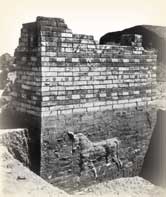
Digging with 200 workers, Koldewey soon was writing excitedly of great finds. A relief he estimated at 960 feet long came to light. He uncovered the enormous walls of Babylon, so wide four span of horses could drive abreast. Babylon had been enormous, larger than any other citadel known to history. Not only this, but it was built of fired brick, not crumbly sun-baked clay. The bricks were stamped with Nebuchadnezzar's name.

Koldewey unearthed the base of a tower on which King Nabopolassar claimed "At that time Marduk [the god] commanded me to build the Tower of Babel which had become weakened by time and fallen into disrepair..." Wherever Koldewey turned his spade, he turned up verification of things the Bible had to say about the great kings and empires that once existed in the Mideast.

Josephus, too, was verified. He had mentioned the hanging gardens of Babylon. The stone arches that supported these were also unearthed by the hardworking German.

The archaeological team shipped the Gate of Ishtar from Processional way of Marduk to Germany and reassembled it to be marveled at by visitors. This was from Babylon's defensive entrance street. On either side of this sunken road, walls rose up forty feet and were lined by 120 stone reliefs with bas reliefs of yellow lions against blue tile. Koldeway shipped many other objects to Germany, among them a basket full of 300 cuneiform tablets.

These were administrative tablets taken from an outbuilding some distance from the Ishtar gate. Nothing much of interest there, it seemed. Not until after 1933 did anyone trouble to fully decipher these bureaucratic texts. But then E. F. Weidener announced an electrifying record corroborating Scripture.

According to Scripture, King Jehoiachin of Judah had been taken into captivity around 600 B.C. Jeremiah says that after a period of suffering the Babylonian King lifted him up and "...Jehoiachin put aside his prison clothes and for the rest of his life ate regularly at the king's table. Day by day the king of Babylon gave Jehoiachin a regular allowance as long as he lived, till the day of his death." Here, on cuneiform was verification of the Biblical text, listing the supplies given king Jehoiachin of Judah. It was a welcome find as critics had long scoffed at the Bible as unhistorical. Koldewey had dug up more than Babylon. He had dug up priceless data that would help us better understand God's word.
Bibliography:
  1. Ceram, C. W. Gods, Graves and Scholars. New York: Bantam, 1962.
  2. Koldeway, Robert. Wieder erstehende Babylon. Leipzig: Hinrichs', 1913.
Read this article at - http://www.christianity.com/church/church-history/timeline/1801-1900/koldeways-verified-the-bible-from-babylon-11630655.html

Mar 9, 2015

Tomb Of ‘Gatekeeper Of God Amun’ Unearthed In Luxor

by
Egypt_tomb_06
An ancient tomb belonging to Amenhotep, guard of the temple of Egyptian deity Amun, has been discovered in the southern city of Luxor, the Egypt’s antiquities ministry said on Tuesday. The ministry said the tomb probably dates to the New Kingdom’s 18th Dynasty (1543–1292 BC). Photographs distributed by the ministry show a tomb with bright green and brown paintings with hieroglyphics. “The tomb contains many stunning scenes with bright colours painted on plaster,” Antiquities Minister Mamdouh Eldamaty said in a statement. “Many of scenes represent the tomb owner and his wife in front of an offering table and a view of a goddess nursing a royal child as well as scenes of the daily life,” he added. The tomb was discovered by a team of American archaeologists alongside an Egyptian inspectors’ team in the city of Luxor, 700 kilometres (435 miles) south of Cairo.

Read the rest of this article at - http://archaeologynewsnetwork.blogspot.com/2015/03/tomb-of-gatekeeper-of-god-amun.html#.VP5hYsItGM-

Mar 5, 2015

DNA Analysis Claims Ancient Elongated Peruvian Skulls Are Not Human

This seems to fit the growing theme of coming "disclosure"...

by ⋅
Ever since their discovery by Julio Tello in 1928, the bizarre Paracas Skulls have amazed and terrified in equal measure. Uncovered in a tomb in South Peru, and believed to be around 3,000 years old, the skulls feature strange elongated craniums which gives them a decidedly inhuman appearance.
In fact, some have claimed they could in fact be the skulls of ancient alien visitors who apparently frequented South America, with other clues including the Nazca Lines and stepped pyramids. Now, an expert on these skulls, Brien Foerster, has claimed he has scientific evidence to back up these claims.

The traditional logic dictates that the skulls were created via a process of 'binding' - in which rope and wood was used to change the shape of a new born infant's skull. This was not unique to the Paracas region, and was practiced all over the South American continent by indigenous tribes. Over 300 elongated skulls of different shapes and sizes were discovered by Tello alone, suggesting the process may have been widespread and used to illustrate a highborn status. The Paracas skulls are particularly strange, however, as they are 60% heavier than most normal skulls.
Foerster, the director of the Paracas History Museum, claims the skulls' DNA is categorically not human. Without informing them of their source, he sent 5 samples of the mitochondrial DNA from the skulls to a geneticist who returned with some rather shocking and ground-breaking results:
It had mtDNA (mitochondrial DNA) with mutations unknown in any human, primate, or animal known so far. But a few fragments I was able to sequence from this sample indicate that if these mutations will hold we are dealing with a new human-like creature, very distant from Homo sapiens, Neanderthals and Denisovans.
One geneticist even went so far as to claim the Paracas skulls are so different from humans' they would not be able to interbreed, claiming: "I am not sure it will even fit into the known evolutionary tree."

Read the rest of this article at - http://moviepilot.com/posts/2015/03/04/dna-analysis-claims-ancient-elongated-peruvian-skulls-are-not-human-2750281?lt_source=external,manual,manual,manual

Jan 7, 2015

Archeologists discover Mythical Tomb of Osiris, God of the Dead, in Egypt

Let me clarify that this tomb "represents" Osiris, and has not been verified as actual proof of his tomb.  I'd expect a lot of Freemasons to be very interested in this locale in either case.  The theory on all this interest in the tombs of ancient kings is not riches or knowledge, but the possibility of acquiring some DNA of these ancient rulers for cloning.  We shall see...

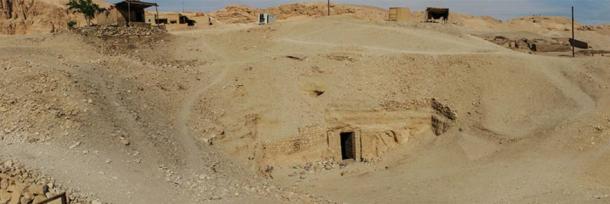
A Spanish-Italian archaeological team, in cooperation with the Egyptian Ministry of Antiquities, has made an incredible discovery in the necropolis of Sheikh Abd el-Qurna, on the West Bank at Thebes, Egypt – an enormous ancient reproduction of the mythical Tomb of Osiris as described by Egyptian legend, complete with multiple shafts and chambers. Inside the tomb complex, researchers found a carving of Osiris and a room with a wall relief depicting a demon holding knives.
Entrance to the funerary complex of Osiris
Entrance to the funerary complex of Osiris. Photo credit: MinProject (Archaeological Mission Canaria-Toscana).
According to the Spanish news agency EFE, the tomb embodies all the features of the tomb of Osiris, as told in ancient Egyptian legends, and is a smaller version of the design of the Osireion, built under Egyptian pharaoh Seti I  in the city of Abydos, Luxor.  Researchers believe the tomb complex dates back to the 25th dynasty (760 - 656 BC) or 26th dynasty (672 - 525 BC), based on a comparison to similar tombs that contain Osirian elements.
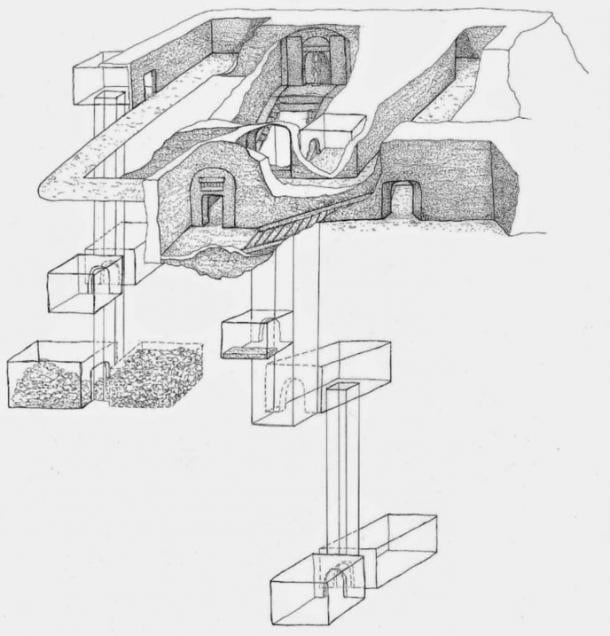
The complex consists of a large hall supported by five pillars. RTVE describes the structure as having a staircase from the north wall of the main room, leading down to the funerary complex, where there is a carving of Osiris, god of the dead, in the middle of a central vaulted temple.

To the west of the central temple is a funerary room with the reliefs of demons holding knives. The leader of the Spanish-Italian team that uncovered the tomb, Dr. María Milagros Álvarez Sosa, told EFE that the demons are there to protect the body of the deceased.

Opposite the statue of Osiris is a staircase with a 29.5 foot (9 meter) shaft leading to another chamber. Inside this chamber is a second shaft that descends 19.6 feet (6 meters) into two more rooms, which are currently full of debris.

“The symbolism of Osiris is very evident here, since all the elements recalling the mythical Osiris tomb are present,” writes Luxor Times Magazine, “a big staircase of 3.5 meter long with a 4 meter high ceiling at the bottom leading to the Netherworld and another one leading directly to the Osiris statue, which is therefore at a higher level and ideally isolated on ‘his island’; the Osiris statue itself; the empty corridor surrounding it which symbolizes the channel of water (see Osireion in Abydos); the expected burial chamber below the statue, thus identifying the deceased with Osiris.”
Sketch showing the outline of the tomb of Osiris
Sketch showing the outline of the tomb of Osiris. Drawing of the tomb's architecture made by Raffaella Carrera, MinProject (Archaeological Mission Canaria-Toscana).
Part of the tomb was initially discovered by archaeologist Philippe Virey in the 1880s and some attempts were made to sketch out the main structure in the 20th century. However, it was not until recently that the full extent of the structure was discovered through excavations. The funerary complex will continue to be explored and the chambers cleared of debris in the Autumn of this year.

Read the rest of this article at - http://www.ancient-origins.net/news-history-archaeology/archeologists-discover-mythical-tomb-osiris-god-dead-egypt-002525

Dec 11, 2014

LA Marzulli - Nephilim | The Evidence


This is never before seen evidence of the Nephilim's interaction with planet Earth in the ancient past and in the present with alien abductions. LA Marzulli presents his new book, On the Trail of the Nephilim II. http://lamarzulli.net/ http://freemantv.com/

Dec 25, 2013

A record 2 million Christians visited Bethlehem in 2013. Why do the ancient prophecies say this “little town” is so important?


In Uncategorized on December 24, 2013 at 2:34 pm
Christmas tree in Bethlehem. (photo credit: Dana Friedlander, courtesy Ministry of Tourism)
 
An estimated 75,000 Christian pilgrims are now in Israel to celebrate Christmas and many will visit Bethlehem, especially tonight on Christmas Eve. By the time the Christmas season is over, ”about two million people will have visited Bethlehem in 2013,” which Israeli tourism officials note is “almost double the 2012 figure of 1.18 million” people.

The “little town of Bethlehem” is beloved, read about and sung about by Christians the world over. But why do the ancient prophecies say it is so important?

The reason is simple: the Hebrew prophet Micah told the Jewish people the Messiah would one day come from “Bethlehem Ephratah.”

In fact, Micah made it clear that the Messiah would not come from the ancient town of Bethlehem that was in northern Israel, near the Sea of Galilee. Rather, the Anointed One had to come from the Bethlehem in Judea, just down the road from Jerusalem.

“But you, Bethlehem Ephrathah, though you are small among the clans of Judah, out of you will come for me one who will be ruler over Israel, whose origins are from of old, from ancient times. Therefore Israel will be abandoned until the time when she who is in labor bears a son, and the rest of his brothers return to join the Israelites. He will stand and shepherd his flock in the strength of the Lord, in the majesty of the name of the Lord his God. And they will live securely, for then his greatness will reach to the ends of the earth.” (Micah 5:2-4)

Why did this matter? Because the Scriptures indicate that the Messiah is to come from the line of King David, and be a “Son of David.” David’s family, of course, was from Bethlehem of Judea. Thus, the Messiah had to be born in David’s hometown in order to eventually emerge as the King of kings and the Lord of lords.

The Gospel account of Matthew indicates that Jesus fulfilled this prophecy.

“After Jesus was born in Bethlehem in Judea, during the time of King Herod, Magi from the east came to Jerusalem and asked, ‘Where is the one who has been born king of the Jews? We saw his star when it rose and have come to worship him.’ When King Herod heard this he was disturbed, and all Jerusalem with him. When he had called together all the people’s chief priests and teachers of the law, he asked them where the Messiah was to be born. ‘In Bethlehem in Judea,’ they replied, ‘for this is what the prophet has written:  “But you, Bethlehem, in the land of Judah, are by no means least among the rulers of Judah; for out of you will come a ruler who will shepherd my people Israel.”‘ Then Herod called the Magi secretly and found out from them the exact time the star had appeared. He sent them to Bethlehem and said, ‘Go and search carefully for the child. As soon as you find him, report to me, so that I too may go and worship him.’ After they had heard the king, they went on their way, and the star they had seen when it rose went ahead of them until it stopped over the place where the child was. When they saw the star, they were overjoyed. On coming to the house, they saw the child with his mother Mary, and they bowed down and worshiped him. Then they opened their treasures and presented him with gifts of gold, frankincense and myrrh. And having been warned in a dream not to go back to Herod, they returned to their country by another route.” (Matthew 2:1-12)

This is why Bethlehem has become such an important destination for Christians eager to visit the Holy Land. Over the years interest has continued to grow, now reaching record numbers of visitors. I first visited when I was in college, during the Christmas season of 1987. I’ve been back several times, and developed friendships with some of the Palestinian Christians that live and serve there today.
Bethlehem — with a current population of about 25,000 – is no longer governed by the State of Israel, but rather by the Palestinian Authority (PA).  However, Israel keeps statistics of how many tourists pass through ”Rachel’s Crossing” between Israel and the PA into Bethlehem. As of the end of October, some 1.85 million tourists had already crossed into the town of Jesus’ birth.
Last month I met at the Knesset with Uzi Landau, the Israeli Tourism Minister. Among other things, we discussed the importance of continuing more Christians around the world to visit the Holy Land, walk where Jesus walked, and see the Bible come to life in living color. Landau noted that it is a very important priority for the Israeli government to reach out to both Protestant and Catholic Christians and make them feel welcome.

Read more at - http://flashtrafficblog.wordpress.com/2013/12/24/a-record-2-million-christians-visited-bethlehem-in-2013-why-do-the-ancient-prophecies-say-this-little-town-is-so-important/

Aug 26, 2013

Aug 1, 2013

The Temple Mount

I should add here that there is some considerable debate as to whether the "wailing wall" is actually part of Herod's Temple (the second temple complex) at all, or actually a wall of the Roman prison that was attached on outside the Temple on the grounds.  We know from Josephus that Herod's Temple was razed to the ground with not one stone left on another.  That would seem to indicate that the western or wailing wall was not actually any part of the Temple, unless it was part of the sub-foundation.

Oct 28, 2012

Man Made Ancient Pyramids Found on Antarctica

A team of explorers is claiming that they have found evidence of at least three ancient man made pyramids on Antarctica!
 

Can it be possible that Antarctica was once warm enough in the recent past to actually have had an ancient civilization living there? And even more perplexing is the question of if an advanced culture did develop there, are there any structures still remaining that are buried underneath the ice? Amazingly a team of researchers is making the claim that they have found evidence of several ancient pyramids on the ice covered continent of Antarctica.
 
So far, the team has not released much information on their discovery although a few pictures have been leaked on the internet recently. I will let you be the judge on if these pictures truly display artificial pyramids or just the rocky tops of mountains but the images are intriguing and definitely warrant further research in my opinion. Three of the images are shown below.
Besides these images, the team is remaining pretty silent with their discovery until more research can be conducted on these pyramids. I was able to obtain some small bits of information from a friend of one of the team members though. The team is made up of 8 explorers from America and several European countries. Two of the pyramid structures were found approximately 10 miles inland while the third one was very close to the coastline. The team is currently planning an expedition to physically reach at least one of the pyramids to determine if it is natural or artificial. No time frame was given as to when this expedition will be taking place though.


Read more: http://scienceray.com/biology/man-made-ancient-pyramids-found-on-antarctica/#ixzz2AZ9YNJCl

Oct 4, 2012

Evidence that Human and Nephilim Experiments Did Co-exist in Ancient Israel

The author intimates in the title that Neanderthal were either offspring of the nephilim, or the results of experiments they may have conducted.  We are on the far edge of sci-fi here....

Archaeological evidence shows that the warring sub-species may have lived peacefully in North Israel.

Sharp flint arrowheads were found by archaeologists at the site in northern Israel [Credit: Alamy]
It may be known for modern- day conflict, but 80,000 years ago the Holy Land may have been the only place where early homo sapiens and neanderthals lived peacefully, new archeological findings suggest.

Archaeologists working on Mount Carmel’s Nahal Me’arot, UNESCO’s most recently declared World Heritage Site, found evidence that the genealogical relatives lived side by side and perhaps even interbred, according to a report in The Times of London.

“If that interbreeding did take place, it must have been here,”said Daniel Kaufman, an archaeologist working at the site.

The Nahal Me'arot (Cave River) nature reserve containing caves used by prehistoric men [Credit: Alamy]
Genetic research showing Neanderthal genes make up 1 to 4 percent of European genes supports the notion of peaceful interbreeding between the two subspecies.

Earlier theories speculated that the relationship was the result of rape between the constantly warring groups.

Archaeologists have found tools of both Homo sapiens and Neanderthals at the Israeli site.

Source:The Jerusalem Post

Sep 25, 2012

The Pharaoh's Chariot Wheels and the Real Mt. Sinai

For those interested in Bible history, this is interesting stuff.  I've been to these locations (not diving) and I'm a believer that the real Mt. Sinai is in Saudi Arabia.  The traditional location in Egypt simply doesn't fit the Biblical description.  Interesting stuff.

Sep 4, 2012

Man Made Ancient Pyramids Found on Antarctica

A team of explorers is claiming that they have found evidence of at least three ancient man made pyramids on Antarctica!
 

Can it be possible that Antarctica was once warm enough in the recent past to actually have had an ancient civilization living there? And even more perplexing is the question of if an advanced culture did develop there, are there any structures still remaining that are buried underneath the ice?
 
 Amazingly a team of researchers is making the claim that they have found evidence of several ancient pyramids on the ice covered continent of Antarctica.
 
So far, the team has not released much information on their discovery although a few pictures have been leaked on the internet recently. I will let you be the judge on if these pictures truly display artificial pyramids or just the rocky tops of mountains but the images are intriguing and definitely warrant further research in my opinion. Three of the images are shown below.
Besides these images, the team is remaining pretty silent with their discovery until more research can be conducted on these pyramids. I was able to obtain some small bits of information from a friend of one of the team members though. The team is made up of 8 explorers from America and several European countries. Two of the pyramid structures were found approximately 10 miles inland while the third one was very close to the coastline. The team is currently planning an expedition to physically reach at least one of the pyramids to determine if it is natural or artificial. No time frame was given as to when this expedition will be taking place though.


Read more: http://scienceray.com/biology/man-made-ancient-pyramids-found-on-antarctica/#ixzz25TEUO7gZ

Aug 29, 2012

Ancient Builders Created Monumental Structures that Altered Sound and Mind, Say Researchers

 By

The results of recent research suggests that ancient, or prehistoric, builders of the monumental structures found in such diverse places as Ireland, Malta, southern Turkey and Peru all have a peculiarly common characteristic — they may have been specially designed to conduct and manipulate sound to produce certain sensory effects.

Hal Saflieni Hypogeum on the island of Malta
Beginning in 2008, a recent and ongoing study of the massive 6,000-year-old stone structure complex known as the Hal Saflieni Hypogeum on the island of Malta, for example, is producing some revelatory results. Like its related prehistoric temple structures on Malta, this structure features central corridors and curved chambers. But this structure is unique in that it is subterranean, created through the removal of an estimated 2,000 tons of stone carved out with stone hammers and antler picks. Low voices within its walls create eerie, reverberating echoes, and a sound made or words spoken in certain places can be clearly heard throughout all of its three levels. Now, scientists are suggesting that certain sound vibration frequencies created when sound is emitted within its walls are actually altering human brain functions of those within earshot.

“Regional brain activity in a number of healthy volunteers was monitored by EEG through exposure to different sound vibration frequencies,” reports Malta temple expert Linda Eneix of the Old Temples Study Foundation, “The findings indicated that at 110 Hz the patterns of activity over the prefrontal cortex abruptly shifted, resulting in a relative deactivation of the language center and a temporary shifting from left to right-sided dominance related to emotional processing and creativity. This shifting did not occur at 90 Hz or 130 Hz……In addition to stimulating their more creative sides, it appears that an atmosphere of resonant sound in the frequency of 110 or 111 Hz would have been “switching on” an area of the brain that bio-behavioral scientists believe relates to mood, empathy and social behavior. Deliberately or not, the people who spent time in such an environment under conditions that may have included a low male voice — in ritual chanting or even simple communication — were exposing themselves to vibrations that may have actually impacted their thinking.” [1]
Researchers at the University of Malta are confirming the findings in an ongoing study.
Inside Malta’s Hal-Saflieni Hypogeum. Courtesy Old Temples Study Foundation
 
But the Hypogeum is not alone in its peculiar sound effects. A study conducted in 1994 by a consortium from Princeton University found that acoustic behavior in ancient chambers at megalithic sites such as Newgrange in Ireland and Wayland’s Smithy in England was characterized by a strong sustained resonance, or “standing wave” in a frequency range between 90 Hz and 120 Hz. ”When this happens,” says Eneix, “what we hear becomes distorted, eerie. The exact pitch for this behavior varies with the dimensions of the room and the quality of the stone.” Going further back in time, she points to the ancient 10,000 B.C. site of Göbekli Tepe in southern Turkey. Built by hunter-gatherers, the site is thought by many scientists to be located in the area transitional to the first development of agriculture and domesticated livestock. Located on a hilltop, it consists of 20 round stone-built structures which had been buried. Those structures that have been excavated feature massive, T-shaped, standing limestone pillars. “In the center of a circular shrine,” she says, “a limestone pillar “sings” when smacked with the flat of the hand. Obviously made to represent a human with a decorated belt and hands carved in relief at its waist, it bears unexplained symbols in the area of the throat.” [1]


And now, new findings of a recent archaeoacoustic study suggests that the ancients of the 3,000-year-old Andean ceremonial center at Chavín de Huántar, in the central highlands of Peru, practiced a fine art and science of manipulating sound with architecture to produce desired sensory effects. With the assistance of architectural form and placement, and sounds emitted from conch-shell trumpets, the “oracle” of Chavín de Huántar ”spoke” to the ancient center’s listeners.

Says Miriam Kolar, Stanford Interdisciplinary Graduate Fellow, PhD Candidate
 at Stanford University and leader of the study: 

”At Chavín, we have discovered acoustic evidence for selective sound transmission between the site’s Lanzon monolith and the Circular Plaza: an architectural acoustic filter system that favors sound frequencies of the Chavín pututus [conch-shell trumpets] and human voice.” [2]

The Lanzon is a sacred statue or stela depicting the central deity of the ancient Chavín culture. Thought to be Chavin’s central “oracle” for its inhabitants, it is housed in a chamber, part of a series of underground passages within the Old Temple of the ceremonial and religious center of Chavín de Huántar. A central duct was built to connect the area of the Lanzon monolith with that of the Circular Plaza, an open-air place of ceremonial activity and significance. The duct was specifically designed to filter and magnify or conduct to a certain sound range — namely, the special range emitted by the Chavín pututu instrument. The specific reasons for this acoustical configuration are not entirely understood, but studies involving human participants within the ancient architectural and artifact context of the site are indicating that the resultant sound effects may have been related to intentional auditory perceptual effects of sound and space on humans.

So what does all of this mean? What explains these similar, yet geographically and culturally disparate finds?

“How curious that such varied ancient structures, separated by so much time and distance, should have common features which imply sophisticated knowledge”, observes Eneix. “Did the architects of the day each make and develop their own discoveries or did they inherit a concept from some older school of learning? Adding the time element to other fields of comparison suggests human trail-blazing of monumental proportion.” [1]

A detailed article about the acoustical qualities of prehistoric ancient architecture is published in the March 2012 issue of Popular Archaeology Magazine, and a live illustrated presentation on the implications of acoustics in the creation of megalithic structures is in production. More information about the lecture, “Sound and the Onset of Building Monumentally” is available from The OTS Foundation.

More information about the temples of Malta and Gozo can be obtained by going to: www.otsf.org and www.ancientmed.org

Aug 23, 2012

From Teotihuacan to Glastonbury - What's the Connection?

A fascinating and somewhat long article, tying together ancient sacred sites with a little bit of math.  Well worth the read.

Section IV, Part 13 – GLASTONBURY vs. ANTIQUITY SITES
By Doug Krieger
1
Introduction to Glastonbury
Our last segments dealt with the Sacred District of Teotihuacán, Mexico. Making the transition from Mexico to Great Britain is no small fete – but we shall try…for there is a multiplicity of happenstance which those of skeptical mind will find all the more disconcerting. So, this article will transition us from Teotihuacán to, of all places, Glastonbury, UK.

The great monuments of antiquity, we affirm, were – in the main – not designed in a vacuum – i.e., they were purposefully measured by an ancient system of metrology based upon the duodecimal code of measurement (i.e., “12”). They were aligned with time (calendrical), space (astronomical) and profoundly cosmological in their consideration as manifested by sundry “cubits” found among the ancients – in particular, the “Sacred Cubit” of the Hebrews derived from antediluvian metrologies recorded in the Sacred Text of the Hebrews.

This “system of measurement” was, by design, known throughout the ancient world and was preserved by the Hebrews – though others mimicked aspects thereof (e.g., the Sumerian foot of 13.2” or the Egyptian Royal Cubit of 20.6” to 20.8”) – notwithstanding, the rotation of the Earth in one solar day is 360° * 7 days (one week) = 2520°…a “palm” or “handbreadth” is 3 ½ inches of 3.6” * 7 (palms/handbreadths) = 25.2” or 2.1 Linear Feet. It is this measurement which constitutes the Hebrew Sacred Cubit – the, if you would, “252” which is a “fractal” (i.e., “resemblance”) of the distance between the Earth and the Moon at apogee: 252,000 miles (i.e., 252 = 252).
2
We have traced the historicity of the Sacred Cubit’s progression and ultimate revival under the British during their “nautical expansion” and encapsulation during, primarily, the Elizabethan Era at the close of the Sixteenth Century. This became known as the “Imperial Mile” with all of its accoutrements such as the inch, foot, yard, mile, furlong, acre and other familiar metrological terms.

Sir Isaac Newton’s quest for the “Hebrew Sacred Cubit” eventually settled upon 2.0736’ or 24.8832” which measurement is really a “double foot” of sorts (i.e., two sets of 12” but exceeding 24” by .8832”). As one can readily observe, Newton’s 24.8832” Sacred Cubit is, in point of terrestrial fact, the circumference of the Earth at its polar meridian – i.e., a fractal of 24,883.2 Miles or 131,383,296 feet or 248,832 = 125 and 248,832 / 10 = 24,883.2 as in Miles (or 125 / 10 miles = 24,883.2 miles).

John Taylor discovered that Newton’s 2.0736’ (24.8832”) Sacred Cubit measurement was six-fifths of the longer Egyptian cubit of 1.728 feet (i.e., 20.736”). (Please Note: 1.728 feet can be seen as a fractal of 12 * 12 * 12 = 1,728 or the very dimension of the New Jerusalem’s side (one of six such sides) at 12,000 furlongs * 12,000 furlongs * 12,000 furlongs = 1,728,000,000,000 cubic furlongs or 1728 = 1728) 

Read the full article at - http://www.the-tribulation-network.com/new_tribnet/ebooks/wonderful_numbers_of_sacred_canon/teotihuacan_to_glastonbury_sec4_pt13.html
 

Aug 15, 2012

Archaeologists Discover Ancient Seal Depicting Samson


Archaeologists of the Tel Aviv University have unearthed a seal, measuring about a half-inch in diameter, which depicts a human figure next to a lion at the archaeological site of Beth Shemesh, located between the Biblical cities of Zorah and Eshtaol.
This is the ‘Samson seal’ found at Beth Shemesh, Israel (Raz Lederman / Tel Beth Shemesh Excavations)
The scene engraved on the seal, the time period, and the location of the discovery all point to a probable reference to the story of Samson, the legendary heroic figure whose adventures famously included a victory in hand-to-paw combat with a lion.

“While the seal does not reveal when the stories about Samson were originally written, or clarify whether Samson was a historical or legendary figure, the finding does help to anchor the story in an archaeological setting,” said Prof Shlomo Bunimovitz.

“If we are right and what we see on the seal is a representation of a man meeting a lion, it shows that the Samson legend already existed around the area of Beth Shemesh during that time period. We can date it quite precisely.”

The seal was discovered with other finds on the floor of an excavated house, dated by the archaeologists to the 12th century BCE.

“Geographically, politically, and culturally, the legends surrounding Samson are set in this time period, also known as the period of the Judges, prior to the establishment of kingship in ancient Israel,” said Dr Zvi Lederman. “The area of Beth Shemesh was a cultural meeting point where Philistines, Canaanites, and Israelites lived in close proximity, maintaining separate identities and cultures. Samson’s stories skip across these cultural borders.”

“Although he was from the Israelite tribe of Dan, Samson is frequently depicted stepping out into the world of the Philistines – even searching for a Philistine wife, much to the chagrin of his parents.”

Although Samson did have some positive interactions with the Philistines — his infamous lion brawl took place on the way to his bachelor party with a group of Philistine men prior to his marriage to his first Philistine wife in Timnah – he is also reputed to have fought against the Philistines. In one tale, this ancient superman is said to have killed 1,000 Philistines with a single donkey’s jaw bone.

“Samson has a very legendary aura,” said Dr Lederman, calling the Samson stories ‘border sagas.’ On one hand, Samsom could cross the border and interact with the Philistines, but on the other, he met with danger and various challenges when he did stray out of his home territory. “When you cross the border, you have to fight the enemy and you encounter dangerous animals,” Dr Lederman added. “You meet bad things. These are stories of contact and conflict, of a border that is more cultural than political.”

The Philistines were immigrants, one of a number of so-called ‘sea peoples,’ originating from the Aegean region. They settled along the southern coastal plain and the lowlands of present-day Israel, including Ashdod, Ashkelon Gaza, Gath, and Ekron. Here they created their own cultural and political enclave and were always seeking to expand their own territory.

“The flourishing Canaanite village of Beth Shemesh, despite frequent destruction caused by their aggressive neighbors, was not abandoned or won by the Philistines and retained its original culture and identity,” Dr Lederman said.